


Belly dancer, horror-film voice actress, and above all a formidable singer and performer. The incredible story of Lili-Marlene Premilovich, one of new wave's most eccentric and original figures. Her visionary art pop, enriched by theatrical vocals and refined arrangements, peaked with \"Stateless\" — though it was far from her only triumph.
Too tender to touch, too fragile to lust
These misty eyes are just enough
A little sign to guide the way
We don’t need so very much
(“Too Tender To Touch”, Lene Lovich)
The Yugoslav Lili Marlene, the oriental dancer who bewitched even Salvador Dalì, the cabaret chanteuse, the shrieking voice of horror films, the avant-garde wave performer, the dark muse with the warm soul of Detroit running through her veins. In short, Lene Lovich, born Lili-Marlene Premilovich, profession: global artist. One of the most influential female figures of her generation, yet, through some strange twist of fate, faded into an intergenerational oblivion, interrupted only by the occasional resurfacing of her chart-topping Lucky Number (“Lucky Number”), a hit that was perhaps even accidental, in a career so promising and so prematurely lost. Too eccentric and wild to win over the masses, Lili-Marlene, with her surreal vocalisations – half chirping, half death-rattle – and her over-the-top vamp look straight out of Transylvania, as if she'd stepped out of some Balkan edition of the Rocky Horror Picture Show. Like a Nina Hagen with an even more unhinged and anarchic voice. So we need to start from the beginning and piece together the mosaic of one of the most intriguing stories of the female wave era.


A Yugoslav in Detroit
Lili-Marlene Premilovich was born in Detroit on March 30, 1949, to a Yugoslav father and an English mother. Incidentally, that same year the automotive capital also gave birth to Suzi Quatro and Stevie Wonder (and five years earlier, to Diana Ross).
During the thirteen years she spent in the fiery Michigan city, it was the music of her peer and fellow citizen Stevie Wonder that would influence her most, along with the entire Tamla-Motown saga.
At home, however, things were rather troubled, to put it mildly (an experience she'd later draw on for one of her most important singles, "Home"), since her father showed clear signs of mental instability, even threatening to move the family to the Soviet Union. When Lili-Marlene was 13, her mother decided to separate and take her and her three siblings to her hometown of Hull, in England.
Now a teenager in Britain, the future Lene showed an interest in both art and music. Around this time she met guitarist Les Chappell and decided to move with him to London to attend art school. Les would become her romantic and professional partner for life.

In 1968 the two attended various institutions, including Central School of Art, where she initially focused on sculpture. This is also where her famous habit of wearing braided hair originated, so as to keep it out of the clay. Over time, though, Lili-Marlene grew disillusioned with the art world, because - as she would later recall - "no one seemed to understand her spontaneous expression of self". She then turned to music, with Chappell's help, who taught her a few guitar chords to go along with her violin studies. It would be a third instrument, however - the saxophone - that became her true means of expression, under the guidance of Bob Flag, leader of Bob Flag's Balloon and Banana Band, one of the first of many musical ventures for the young Premilovich, who reveals she already had pretty clear ideas back then: "I learned to play sax because people weren't ready for my voice yet".

Time spent in the underground scene of the English capital showcased her early talent, combined with the eccentric look and hairstyles that would later make her famous.
In the early 1970s, she chose the alias Lene Lovich and began throwing herself into a variety of artistic pursuits. Besides playing sax with Flag, she worked as a street musician, sang in a choir for the show "Quintessence" at the Royal Albert Hall, and even worked as an "oriental dancer" in a cabaret! She also traveled through Spain, where she got to meet Salvador Dalí, worked as a touring dancer on the "Radio One Roadshow", promoted by a well-known commercial radio station, and toured Italy with a soul band called West Indian Soul Band.
While at the Lancaster Arts Festival, she was chosen, along with others, to provide backing vocals on Chuck Berry's single "My Ding-A-Ling", released on Chess Records. It was her first appearance on record: the single would reach number one on both the UK and US charts.
In 1975, together with Chappell and other musicians, she formed a funk/disco band called The Diversions. In the group, where she played sax while Les backed her on guitar, they recorded a handful of covers, including Carl Malcolm's "Fattie Bum Bum". But none of those singles achieved any success whatsoever. The road ahead, in short, seemed to be all uphill. Until a strange phone call came in...
On the dancefloor with Cerrone
For a hundred miles or more
You can hear the people cry
But there’s nothing you can do
Even God is on their side
Supernature
(Cerrone, “Supernature”, 1977)
While Lene is in the studio with Diversions, the phone rings. "They were looking for someone to work with this foreign guy who didn't speak much English, but he was into disco music, and since we did soul/funk, somehow they came to us – Lovich herself would recount – And I, grabbing every opportunity, whether I could handle it or not, said I could do it, and since I'd raised my hand I found myself on a plane to Paris and had to figure out how to deal with this new thing".
Upon her arrival in the French capital, the mission is finally made clear: Lene is recruited to write English lyrics for French disco star Cerrone. Though uncredited on the records, she ends up collaborating on three of the Gallic composer's works, including the legendary hit "Supernature": yes indeed, it's the young Lili-Marlene who pens the lyrics and sings, with her commanding tone, amid the lush keyboards of that eternal dancefloor-filler. A contribution that was anything but secondary to the success of the French producer's electronic masterpiece, even if she remained almost incognito at the time. She would symbolically reclaim it with a rockier cover version in 1987.
During her time in France, Lene added yet another line to her already varied résumé: that of "screamer" for horror films - and given her vocal range, it doesn't seem all that strange.
Meanwhile, despite an attempt to record a Christmas single with Lovich singing "I Saw Mommy Kissing Santa Claus" in a "horrendous Shirley Temple-style voice", the Diversions failed to break through and disbanded in December 1976.
But in a remarkable turning point, just as the dream ended for the band, it began for Lene. Once again, a phone call was involved: this time it was Lene herself who picked up the receiver and reached out to the right person. Specifically, Charlie Gillett, writer and disc jockey, host of a radio show that offered aspiring musicians airtime to promote themselves. "My name's Lene. I play sax and I'd like to join a band," she told him. Gillett broadcast her phone number but, as she herself would recall, "nobody called! Not a single person, and there I was sitting right next to the phone". Later, though, Lene wrote Gillett a letter telling him a bit more about herself. And that was enough to convince the DJ to record a demo of "I Think We're Alone Now", the Tommy James and the Shondells classic that a few years later would become a worldwide hit in Tiffany's version, and which Lene herself would go on to record in other languages too, including German and Japanese. Gillett brought the tape to Dave Robinson at Stiff Records, who was instantly captivated and decided to sign this magnetic artist named Lene Lovich.
From the very beginning, Lene thought of this new project as a collaboration between herself and Les. But since Les preferred to stay behind the scenes, and Stiff feared a possible future breakup, they simply decided to use the name Lene Lovich alone. It marked the official start of her solo career.
The stateless chanteuse
In July 1978, Stiff released a first limited pressing of the cover of "I Think We're Alone Now". It was the first single credited to Lene Lovich: an unimaginable hybrid of the elegant soul of the Supremes and the wild punk approach of Patti Smith.
Also in 1978, in Paris, Lene recorded "Jungle D.J." for producer Michel Elmosino, immediately included on the disco-funk album "Jungle D.J. & Dirty Kate" credited to Kikrokos (actually a trio featuring the producer, André Allet and Patrick Sesti). It would enjoy modest success, but nothing more.
After taking part, in the summer of 1978, in the "Be Stiff Route 78 Tour" (also her first American tour) alongside other artists on the label's roster (Rachel Sweet, Eric Wreckless, Mickey Jupp and Jona Lewie), Lovich was finally ready to release her debut album, Stateless (1978), destined to remain her most celebrated work. And the credit undoubtedly goes to the single that drove it to success.
Legend has it that when the fearless Lili-Marlene played "Lucky Number" to the Stiff top brass, more than a few of them turned their noses up at that nonsense refrain ("Uh-oo-uh-oo"), starting with label boss Dave Robinson, who reportedly exclaimed: "That's supposed to be the chorus?!" So much for record executives' foresight... As it turned out, "Lucky Number" shot up the UK chart all the way to number three, turning Lovich into a pop star practically overnight. Because, as she herself explained: "Sometimes, when there isn't a word to express what you want to say, you use the one that comes closest, or you invent a sound that comes close". But beyond those guttural, grotesque vocal flourishes - which would go on to become a trademark for a host of future punk singers, from Siouxsie to Nina Hagen - "Lucky Number" also nails a formidable dance-punk gait, dazed and skittish, built on an electronic backbone as powerful as it is minimal, closing out with percussion that even hints at industrial. A triumph, but also a curse, since for many people the name Lene Lovich would remain forever tied to that one hit, as if she were just another pop one-hit wonder.
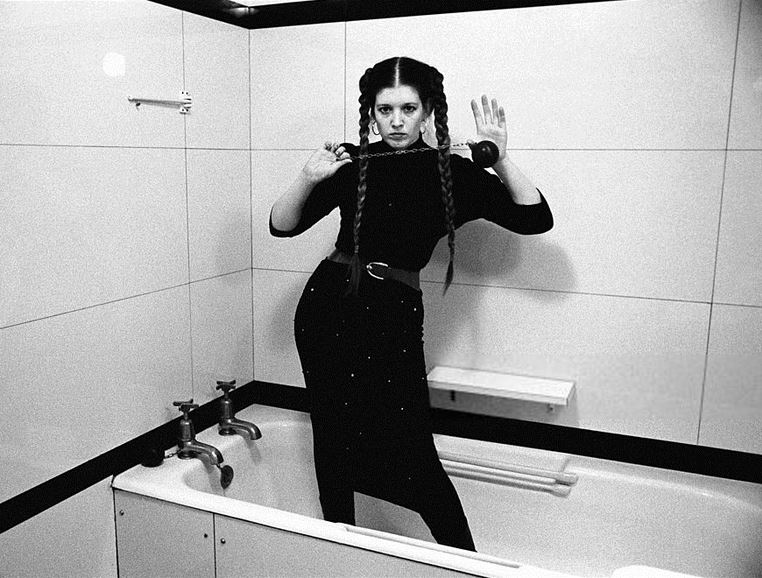
And yet, right from her debut album, you can sense the makings of a true rock leading lady. Stateless stages a kind of spiritual liberation: a lifestyle, a constant urge to throw her own independence in the listener's face. An unrestrained attitude that also comes through in the excesses of a Transylvanian-princess look, all heavy make-up, long henna-colored braids, black lace mantillas and vividly colored outfits. Musically, meanwhile, an important presence within the concept is Jeremy Green, the veteran sound engineer behind some Clash records, who lends the whole thing a sense of new wave freshness. But towering over everything is Lene Lovich's incredible voice, running through the entire album as it alternates between trills, shrieks, whispers and unpredictable vocalizations. A shapeshifting instrument, capable of swinging from surprisingly deep tones to eardrum-splitting shrieks.
After the triumphant opener "Lucky Number", the following "Sleeping Beauty" shifts gears with a syncopated groove and vaguely Spanish shadings, once again letting Lene Lovich's unmistakable voice dominate the scene. "Home" - dedicated to her troubled childhood in Detroit - represents the album's darkest moment, built on a relentless rhythm section and the unsettled mood conjured by the organ, while "Say When" abruptly raises the stakes with the record's most energetic, punk-adjacent moment, driven by Lovich's vocals - by turns slyly coy and intensely expressive - before she goes on to explore every register of her theatrical crooning in the sinister weave of "Writing On The Wall", which builds to a hugely impactful chorus. The brighter, more immediate "Telepathy" follows, then the darker but equally brilliant "Momentary Breakdown".
"Too Tender (To Touch)" is an incredibly underrated masterpiece: an art pop track with Kate Bush-like tendencies that turns into something more and rules over a lush harmonic structure; Nick Plytas's pounding yet fairy-tale-like piano reigns over the whole song, as does Lovich's statuesque voice, here more than ever in a state of grace.
The ironic "One in 1,000,000" spotlights Bobbi Irwin's tremendous drumming and a Nina Hagen-esque attitude, while the tender "Tonight", a cover of a Nick Lowe song, hints at a clear departure from traditional pop song structures: her saxophone lends the track a magical atmosphere, but it's the refrain - anything but simple - that lingers in the mind.
The album closes with the aforementioned - and successful - reinterpretation of the Sixties soul classic "I Think We're Alone Now", which had marked her debut single for Stiff: an irresistible number built on swaying synthesizers, surreal backing vocals and a striking, sky-high note at the finale.
Later reissues would add various bonus tracks, among which at least the irresistible surreal post-punk gallop of "Be Stiff" and the bleak cabaret pantomime of "One Lonely Heart" deserve a mention.
Overall, Stateless is a fantastic debut, one that skillfully balances experimental sounds with pop accessibility, showcasing a singer-performer with a unique voice and a bizarre approach, one that would make her both an icon and a forerunner of the emerging new wave scene. Like some alien deity who landed on Earth with the sole purpose of becoming a pop star. A bit like Ziggy Stardust, but with one key difference: she really does seem to come from another planet.

Gothic rituals, dancefloors and Japanese manga
In 1979 Lene settled in the Netherlands and took the lead role in the film "Cha Cha", directed by Herbert Curiel, alongside her German "punk twin" Nina Hagen. The film sent real shockwaves through Amsterdam's underground scene. She also composed the soundtrack with Hagen and built an intense working relationship with her: the Berlin-born artist would pay her tribute by recording a German-language version of "Lucky Number" ("Wir Leben immer noch") on her album "Unbehagen", and later, in 1986, would sing with her on a song against animal cruelty, "Don't Kill The Animals", included on various compilations.

After launching her artistic debut on LP, the Anglo-American singer-songwriter shifted her focus toward an increasingly accessible sound. Flex (1980), her second official record, released roughly two years after its predecessor, condenses a more classic new wave sound that occasionally drifts into dance territory. The esoteric dub of "You Can't Kill Me" gathers up her strange, gothic sensibility and elevates it into something untouchable: the song's choral quality, built on a ritualistic feel, floats over a deconstructive yet captivating melodic line. But it's above all the two brilliant singles that made inroads on the British charts. The first, "Bird Song", after a suspended intro built on synthesizers and bird calls performed by Lovich herself, bursts into an irresistible wave rhythm: Lene - here closer than ever to Siouxsie's register - shows off her full vocal range and crafts one of the album's most memorable melodies, while the chorus, propped up by near-epic male backing vocals, makes the track even more compelling. The other single, "Angels", sticks to a similar formula, with electronic effects up front, tight rhythms and a caricatured flair reminiscent of the debut's most frenzied moments, albeit with a slightly more controlled approach.
As on Stateless, much of the album plays with a B-movie sci-fi imagery, full of electronic synths, sound effects and deliberately kitsch atmospheres. "What Will I Do Without You?" (co-written with Chris Judge Smith, former member of Van Der Graaf Generator) is a perfect example: a classic wave structure enriched by jittery basslines and a cascade of subtle, pulsing synths.
Among the most successful tracks is also "Wonderful One", enlivened by the sprightly sound of the xylophone, which lends lightness to the rhythm and accompanies a simple but effective melody. "Monkey Talk", on the other hand, showcases all the singer's theatricality, alternating between shrieks, giggles and unconventional vocal inflections.
Where on her debut Lovich had surprised with a highly personal take on "I Think We're Alone Now", here she attempts to repeat the trick by reinterpreting "The Night" by Frankie Valli & The Four Seasons (written by Bob Gaudio-Al Ruzicka), in a dazed jazz-cabaret version that proves no less surprising.
The second half of the record gradually loses steam. "Egghead" flaunts a crooked but not especially incisive melody, while the martial "You Can't Kill Me" stands out mainly for its sound effects, evoking a space battle, without being backed up by equally solid songwriting. The closer is "The Freeze", a track rich in timbral touches - sea sounds and cosmic synths alike - that suggests a curious encounter between old British sea shanties and electronic sci-fi imagery.

Overall, Flex is a less groundbreaking follow-up to Stateless, but it retains all the charm of Lene Lovich's creative universe. CD reissues would also add "New Toy", one of the finest singles in her catalogue.
The album's moderate success convinced Lene Lovich to embark on an exhausting European and American tour that kept her busy for the entire season. In February 1980, during the Italian leg of the promotional run, she also gave an interview to Federico Guglielmi for Il Mucchio Selvaggio, expressing all her enthusiasm for the sweeping wave fever gripping the Old Continent: "Before new wave, music was getting more and more boring, and all the major labels were closed off to new ideas: they were always looking for the next Beatles or the next Bee Gees... I really like the Undertones, and also a Californian band called the Residents: they have a great sense of humor and a more human way of using electronic instruments". And when asked "how do you explain the fact that so many girls are in new wave bands, after so many years in which female presence in rock was quite limited?", she replies firmly: "I think it's more stimulating for women to be involved in music now; before, to be successful, a girl had to fit a certain stereotype: being sexy, or looking sweet and innocent, that sort of thing. Now a girl who really feels creative and wants to do something of her own can simply be herself, without needing to try to resemble someone else".
Very clear ideas, then, despite the eccentricity, including an awareness of her own personal vocal style, made up of sounds, sighs, screams and noises that led some to compare her to Yoko Ono. A style behind which lies a precise artistic philosophy: "Sometimes you can create an emotion without saying a single word," she would explain. "It's something almost subliminal, but it's direct communication. The human voice is the most effective instrument for reaching people. Every song I write is meant to create an atmosphere, an emotion, so I can tell my story."
The voice, then, as a musical instrument in its own right. Paired with a curious system of field recording ante litteram: "I always keep a small tape recorder by the kitchen sink, ready to capture any melodic idea. It's the most practical way to record my ideas. As a kid I used to write on a piece of paper 'da, dum, da, de, da, dum, dum'. The next day I could no longer understand what it meant. The invention of cassette recorders changed my life".
In 1981 Lovich released a double EP featuring the aforementioned "What Will I Do Without You", already included on Flex, plus four songs recorded live at the Lyceum in February 1980. Later that year, she released another successful single, "New Toy", a biting synth-pop satire on consumer society, written in collaboration with British composer and keyboardist Thomas Dolby: it introduced her to Italian audiences too, where it landed in the lower reaches of the charts (No. 24), and stormed the US charts, climbing all the way to number three. The song, incidentally, would go on to be used as the closing theme for the animated series "Attacker You!", the original version of the popular manga series later known as "Mimì e la nazionale di pallavolo".
The shadow of oblivion
The euphoria of success, however, gradually begins to fade. The third studio work released under the name Lene Lovich, No Man's Land (1982), rides on overblown, danceable rhythms that are at times rather superficial: what really holds the concept together is Chappell's production, which on tracks like "Walking Low" clearly brings out our heroine's dark compositional potential. Even in the refrain of the opening "It's You, Only You (Mein Schmerz)" – an anxious, incalzant synth-pop number featuring Nina Hagen – there seems to be an almost Morricone-esque echo.
"Blue Hotel" is a dark, atmospheric episode, with a subtly spectral mood that exploits every nuance of Lovich's prized voice: it's the song with which – like an alien landed at the Ariston – she would even compete at the 1982 Sanremo Festival, placing eighth (a huge result, given the context!).
Less well known but much loved by fans, "Sister Video" highlights the Lovich-Chappell duo's skill in crafting a refined, homemade synth-pop, incisive too on the pounding "Faces", almost a subtle parody of Siouxsie in a kitsch flavour.
Overall, the record makes for light, pleasant listening, but light years away from the debut in terms of musical substance and experimentation.
The following March (1989) – written and produced in the United States together with Les Chappell, who had in the meantime become her husband – recalls an even softer version of "Blast The Human Flower" (1990), the final studio album by British artist and composer Danielle Dax, before her gradual withdrawal from the scene. What emerges is a work seemingly ten years out of step with the advent of new wave, marked by strong synthetic overtones. The drum machine, as well as the singer's own co-production, does nothing to soften the coldness of the sound the listener is forced to endure.
But while the only track that truly stands out is the irresistible single "Wonderland", most of the album is nonetheless a pleasant listen, still managing at times to surprise (the overexcited electronic novelty of "Nightshift", the funky synth-pop of "Vertigo", the surreal little march of "Shadow Walk" with Chappell's added vocalisations mimicking a croaking frog), despite a few overly precious mannerisms and a persistent sense of déjà vu running through the tracks.
An all-too-homemade work: aside from a few bass and percussion contributions, Lovich and Chappell wrote, produced and played the entire album by themselves.
In the years that followed, Lene Lovich once again drifted away from rock, partly for family reasons, having in the meantime become a mother of two daughters. She did not, however, give up on her creativity: she released a few works for the Pathfinder Jazz label and, together with Les Chappell and Chris Judge Smith, staged the theatrical production "Mata Hari", dedicated to the famous First World War spy. At the same time, she also began writing a novel.
Meanwhile, though, Lene Lovich increasingly became a muse for a new generation of artists: in 1991 she was called in by Erasure to collaborate on "Rage", while in 1999 electronic dance pioneers The Chemical Brothers invited her as a guest star on the track "Shape Shifter".
Meanwhile, she revealed some unexpected musical tastes. In interviews, among her key influences she cites Dusty Springfield, alongside major names of British rock from the Sixties and Seventies such as Animals, Rolling Stones, Led Zeppelin, Incredible String Band and early Pink Floyd, as well as albums like "Waiting For The Sun" by The Doors. Among her electronic passions she mentions early Kraftwerk, while in more recent years she has expressed admiration for Rammstein, Bloc Party, Electric Six and The White Stripes, proof of an ever-open approach to new music.
The final cry
Fifteen years to the day pass since the Detroit artist's last work, which – following various collaborations with Peter Hammill of Van der Graaf Generator and with Hawkwind – she released what to this day remains her final recorded testament. Shadows And Dust (2005) raises the bar compared to its predecessor and shows a feisty Lovich, albeit within the limits of her songwriting. Partly produced by Mike Thorne, the veteran producer who helped shape post-punk-inflected psychedelia with the initial album trilogy of Wire, and even the synthetic minimalism of Soft Cell, the record is anchored by full-bodied guitars, a stoic voice and, quite simply, breathtaking synths.
Lene seems not to have lost an ounce of her eccentricity, retaining the traits that have always made her unique: theatricality, a taste for the grotesque, irony and a fascination with the supernatural never taken too seriously. While much gothic music tends to indulge in solemn or melodramatic poses, Lovich has always gone the opposite way, turning vampires, witches, ghosts and magic into a playful, campy universe, irresistibly fun, where kitsch is always an asset, never a synonym for bad taste or pretension.
Musically, the record stays true to the dark synth-pop coordinates that have always defined the American artist, but with a production that evokes the aesthetic of old horror B-movies. The electronic backing retains a retro charm, the guitars add a rough rock edge, and the keyboards, at times close to Depeche Mode, fill the arrangements with unsettling atmospheres. The result is a kind of gothic funfair, where each track introduces a new sonic detail: the spectral bells of "Ghost Story", the menacing strings of "Remember", the industrial distortions that open "Gothica", the swampy textures and warped vocals that turn "The Insect Eater" into a horror nursery rhyme dedicated to Dracula's apprentice.
Lene's voice, inevitably rougher than in her early days, remains the heart of the album throughout, leaping from tender tones to animalistic screams and switching between cabaret inflections, theatricality and madness with an ease that once again recalls her "sisters" Siouxsie Sioux and Nina Hagen. Chappell also plays an important role, his backing vocals broadening the sound without ever stealing the spotlight from the star of the show.
Despite its dark atmospheres, Shadows And Dust runs on a thread of irony and lightness. "Shape Shifter", the only single taken from the album, wins you over with jagged rhythms, unpredictable arrangements and a contagious chorus reminiscent of the playful energy of Siouxsie And The Banshees's "Peek-A-Boo". "Gothica", meanwhile, is almost a personal manifesto: behind the dark imagery lies the idea of a refuge from normality, a place where there is nothing left to fear ("It's a necessary refuge from the ordinary", "I have nothing more to fear").
Even when dealing with darker themes, Lovich shies away from any seriousness or self-pity. "The Insect Eater" plays with the figure of the vampire through an amused horror fairy tale. "The Wicked Witch", dedicated to prejudice against paganism, responds to fear and ignorance with sarcasm rather than anger. "Ghost Story" alternates ghost stories with one of the record's most intense vocal performances, while "Craze" intrigues with unusual combinations of keyboards and guitars.
Among the album's finest moments is also "Little Rivers", a delicate, melancholic ballad that shows Lovich has lost none of her ability to move the listener. Likewise, "Remember" reveals a more theatrical, reflective side of the Detroit chanteuse, confirming that beneath her taste for playfulness lies a remarkable interpretive sensitivity.
The album constantly alternates lighthearted moments with more introspective passages, taking the listener on a journey through a world populated by witches, ghosts and monsters, told with a playful spirit, imagination and self-deprecating humour. A mood that sits somewhere between the more accessible Klaus Nomi and the more visionary Danielle Dax, at times evoking the eccentric imagery of "The Wizard of Oz".
Without any particular high points, Shadows And Dust remains a well-executed exercise in style that reveals an alternative side of the American singer-songwriter: an artistically minded new wave that still, in its own way, makes for a genuinely original listen today.

A year later, Lovich took part in a tribute album to Giuni Russo, "Unusual" – alongside Franco Battiato, Caparezza, MegaHertz and various other artists – reinterpreting the song "Moro perché non moro". Also in 2006, she took the stage with the Dresden Dolls at a concert at London's Roundhouse, a performance included among the extra content of the band's DVD "Live At The Roundhouse".
In 2011 she played the role of Eurydice in Judge Smith's opera "Orfeas". Two years later she also contributed to Smith's album "Zoot Suit" and to Mr. Averell's "Gridlock".
After her 2005 return to recording, Lene also reappeared on the live scene in 2012 with a new band featuring Jude Rawlins, leader of the Subterraneans, on guitar, Lydia Fischer on bass, Kirsten Morrison on keyboards and Morgan King on drums, with her longtime partner Les Chappell absent for the first time in her career. The new Lene Lovich Band made its live debut on 29 October 2012 at London's 12 Bar Club. The following year saw her first major tour, which wrapped up with shows in London and Berlin and an appearance at Rebellion Festival. In 2014, Valkyrie replaced Fischer on bass for the band's first major European tour. The group returned to Rebellion Festival in 2017, before embarking on Lovich's most extensive tour in 27 years, supporting The Psychedelic Furs.
In September 2013, Lene Lovich and Jude Rawlins founded the label Flex Music, gaining control of the Detroit artist's back catalogue for the first time. The label debuted with the limited-edition CD box set Others: Volume 1, featuring Lovich's first three albums plus a bonus disc of rarities, while in 2023 Cherry Red released the four-CD box set Toy Box, collecting the material Lovich recorded for Stiff between 1978 and 1983.
Finally, in 2025 Lene Lovich returned to the stage with a series of solo shows in North America and opened dates on The B-52's and Devo's "Cosmic De-Evolution" tour.
Here, for now, ends the wild fairy tale of Lili-Marlene Premilovich. Until new chapters come along, all that's left is the pleasure of leafing through its pages once more, like one of those childhood picture books that always left us open-mouthed.
Add OndaRock to your favorite sources on Google Discover. Don't miss our reviews, milestones and latest news straight in your feed.
This article is an English translation of the original Italian text, published on OndaRock.it. It was translated with the help of artificial intelligence, under the editorial responsibility of OndaRock's editor-in-chief, Claudio Fabretti.
| Stateless (Stiff, 1978) | 8 |  |
| Flex (Stiff, 1979) | 7 | |
| No Man's Land (Stiff, 1982) | 6,5 | |
| March (Pathfinder, 1989) | 5 | |
| The Best of Lene Lovich (anthology, 1997) | ||
| The Very Best Of (anthology, 1997) | ||
| Lucky Number - The Best Of (anthology, 2004) | |
|
| Shadows And Dust (2005) | 6,5 | |
| Toy Box (box, Cherry Red, 2023) |
 MilestoneRecommended by OR


