


Formed as a duo obsessed with the deafening drone of Earth and the excruciating slowness of Melvins, they have become one of the most important experimental metal acts of the past twenty-five years. A long inner struggle resolved into a moving spiritual landing
 A young man of Italian descent works in an English factory. It's the mid-1960s, and the music scene in Birmingham, where the young man lives, is buzzing with activity. A workplace accident, however, mutilates his fingers: he loses the last joint of his middle and ring fingers. He considers giving up the guitar for good, but then he hears one of the most talented jazz guitarists of all time, Django Reinhardt. Even though Anthony Frank, as the young man was christened, isn't exactly a jazz aficionado, he's still a guitarist: he's immediately struck by that prodigious European jazzman. But for Anthony Frank, it's not Reinhardt's creativity that makes the difference, so much as his personal story: that jazzman had survived a serious fire that maimed and scarred him, forcing him to play with two paralysed fingers on his left hand. Written off as finished, he kept playing guitar, overcoming his disability. For Anthony Frank, known to friends simply as Tony, it's a revelation. And that very Tony, surname Iommi, goes on to become the guitarist of Black Sabbath. Over time, he starts tuning his instrument down, to make it easier to play with his mutilated hand, and in doing so discovers a cavernous, menacing sound. Within a few years, Black Sabbath become legends of heavy metal and the foundation of doom metal: heavy, slow music dominated by down-tuned guitars, dealing with dark themes.
Black Sabbath, the band led by Tony Iommi but also home to the famous Ozzy Osbourne, didn't always go by that name. Initially, they'd chosen a fairly unremarkable one: Earth. So uninspired, in fact, that there was already a psychedelic band in England going by that name, and it's also the name of a third, largely forgotten band, the one originally fronted by Bruce Springsteen. Keep that name in mind, because it's going to come in handy shortly.
In the twenty-odd years in which humanity had no notable band called Earth, a lot happened in heavy metal. Since the days of Black Sabbath, this harsh, deafening musical style became an institution of the 1970s, absorbed ideas from punk, and mutated into new, increasingly fast and extreme styles throughout the 80s and early 90s. Alongside this evolutionary line, though, there are at least two others: the pop-metal commercialisation route, and the slow, heavy path of doom metal. We'll focus precisely on the latter, if only because it's the most overlooked offshoot of 80s heavy metal, while favouring an unusual perspective.
 Rather than dwelling on the classic exponents of this style, among which Pentagram and Candlemass stand out, let's focus on the guitar riffs and the slowness of the playing. Scanning the doom-metal landscape with this in mind, we find one band that, more than any other, seems determined to embody the idea of slow and heavy in music: Melvins, from Washington. As early as 1987, with their debut "Gluey Porch Treatments", they prove their belief in rock played at half-speed, chaining the fury of hardcore punk to deafening, cacophonous guitars, effectively inventing sludge metal. In 1991 comes "Bullhead", which contains one of the key turning points in the story we're telling: "Boris", eight and a half minutes of Black Sabbath at half speed, with the guitars front and centre, stubbornly insisting on mechanical repetitions, thrilling celebrations of the instrument's sonic power.
In 1992, Melvins surpass even that peak of slowness and heaviness with their self-titled album, better known as "Lysol", and tracks like "Hung Bunny", an 11-minute colossus dominated by a magmatic river of distorted guitars, with a barely-there rhythmic structure that only stirs after 8 minutes. Time almost grinds to a halt, the sound floats in space and absorbs the listener. Every note is a sonic ritual, so sacred is the wait for the next pick stroke.
We mentioned the name Earth, discarded by Black Sabbath because it was shared with a fellow countryman band. When Dylan Carlson, a guitarist from Washington, founded his band in 1989, he chose that very same bare-bones name. The masterpiece "Earth 2: Special Low Frequency Version" (1993) is the extreme version of the slowest, heaviest Melvins. Three tracks in 73 minutes, one of which even exceeds 30 minutes. All instrumental, with the almost total absence of rhythmic instruments. At the time, Carlson called it ambient-metal; today we call it drone-metal. Drone is a note sustained for a long time, sometimes for whole minutes on end. Drone-metal uses the guitar to produce boundless, psychedelic sounds that shift and mutate through feedback, echoes and distortion.
In the prehistoric The Grimmrobe Demos (1999), 500 copies later reissued in 2005 for the benefit of completists, Sunn O))) go out of their way to pay tribute to Earth: one of the three tracks on the original edition is literally titled "Dylan Carlson". But these demos, despite their borrowings from the founders of drone metal, are still terrifying for ears and soul alike. Three tracks, 55 minutes. The first, "Black Wedding" (19 minutes), emerges from the darkness and uncovers alien psychedelic visions while pushing forward a deafening, murky guitar riff, the product of a tuning so detuned it makes Iommi's historic low-end look tame by comparison. "Defeating: Earth's Gravity" (15 minutes) strips away even the psychedelic smears, focusing instead on the stunning effect of the slashing guitar blows, though after ten minutes a kind of doom-metal solo emerges and in the finale the sound clears up, finally settling into galactic vibrations. The already-mentioned "Dylan Carlson" is a 21-minute composition that grinds out an extremely slow guitar riff for a few minutes only to open onto an atmosphere of unbearable tension and launch into the next riff, finding in the end a glimmer of humanity in the guitar's wails.
The 2005 version adds the 17 minutes of "Grimm & Bear It", opened by a blaze of distortion unusually high-pitched for their register but still dominated by funereal riffs and closed by a long, hallucinogenic coda.
 The Grimmrobe Demos is the band's starting point, evidence of their most blatant fascination with Earth. It serves above all to define an extreme aesthetic, built on the physical impact of sound and a different conception of time in music. It's with the following ØØ Void (2000) that, behind the tribute, one begins to notice a band destined to leave its mark on heavy metal at the turn of the millennium. Four tracks, 58 minutes: roughly 15 minutes per track, enough to sketch the outline of a "format".
It opens with "Richard", and it's already a different world compared to the demos: the deafening pair of guitars dominates, but around the ninth minute the devastating vibration of the drone clashes with sharper guitar radiations, so icy they recall black-metal aesthetics. Toward the end it's precisely this radiation that takes over, in a dissonant jubilation that recalls classical avant-garde more than "Earth 2". "NN O)))" interrupts the assault on the eardrums halfway through, hinting at the anguished solitude hiding beneath the duo's funereal music.
Remember when we talked about Melvins and their "Hung Bunny"? The third track, "Rabbit's Revenge", is an imaginative reinterpretation of an obscure song the Washington band used to play live early in their career. The tribute is made explicit, so to speak, by a sample dropped in after the fifth minute. It is, in other words, no ordinary rabbit. The last track, "Ra At Dusk", takes its rhythm from a distorted, out-of-control vibration, closely recalling German cosmic excursions. It's the most extreme track in compositional terms, a cloud of sound where the musical gesture is often unrecognizable: having unleashed the full power of the guitar with its arsenal of distortions and effects, the two simply steer its deafening monologue.
As minimalism teaches us — and Sunn O))) draw more from its compositional and aesthetic philosophy than might appear — variation can be detected by the listener only if they accept being drawn into the composition. The duo sets up a grim environment, an endless night that will soon take on mystical overtones. It leaves the eye (figuratively speaking — really, the eardrum) time to adjust to all that blackness. Submerged in anguish, surrounded by so much oppressive power, the eye becomes alert to the slightest movement. It's not just fear, but a different state of attention in which time seems to stop existing and the innermost perceptual sphere becomes vivid, the only tool left for finding one's bearings.
 Flight Of The Behemoth (2002), after two more drone-metal giants in "Mocking Solemnity" (9 minutes) and "Death Becomes You" (13 minutes) — essentially one single monstrous tribute to Earth yet again — unveils a new musical soul. It's actually the following two tracks, mixed by Japanese noise giant Merzbow, that bring out classical-leaning touches so far kept well hidden. A piano dominates the opening of "O))) Bow 1", while after the usual grim drones the guitars try to reclaim ground with mid-frequency slashes worthy of the most uncompromising walls of noise. The tormented litany of distortion is decidedly more eventful than anything the band had released before, and the sudden sonic assaults inject an unprecedented dynamism. "O))) Bow 2" emerges from the soul's blackest night with chainsaw guitars and a death-wind blowing furiously. The overall sound is so deafening that the ever-present drone vibration ends up buried beneath it. When inverted sounds and terrible piano dissonances, at eardrum-splitting volumes, step into this inferno, the bridge between electronic manipulation, dissonant classical avant-garde and drone metal is firmly established once and for all.
The "O))) Bow" pair marks a fundamental turning point in the band's career: their first collaboration with a major outside artist opens the door to different, experimental sonorities, in dialogue with the avant-garde and noise. An aesthetic milestone only partly scaled back by the closing "F.W.T.B.T.", an unrecognizable tribute to Metallica's "For Whom The Bell Tolls", which brings back bass and drums, drawing the band closer again to their beloved Melvins.
The path toward the band's future has now been laid out: experimentation and openness to outside contributions, in order to break free of the by-now well-worn groove carved by Melvins and Earth.
White1 (2003) features the many-sided Julian Cope, who for the occasion recites an esoteric poem over "My Wall", the 25-minute opening track. The guitars make room for the voice, for the first time in the band's discography. The recitation is far removed from the sound of their debut, accompanied by whistles and spectral melodies that only in the second half give way to thicker, more deafening drones. "The Gates Of Ballard" opens with the voice of Runhild Gammelsæter, a singer already heard in the short-lived Thorr's Hammer, a band that also featured Anderson and O'Malley but which, in its first incarnation, lasted only a handful of weeks. After the vocal contribution come bass and drum machine, which, after about 9 minutes, give way to the now-familiar drones before returning for the finale. Even though it sounds almost comical to say so, it's the most rhythmic track Sunn O))) have ever composed, even if it doesn't seem to carry forward many ideas across its ample 15-plus minutes.
The third and final track, "A Shaving Of The Horn That Speared You", opens with a guitar flickering in the dark with sparse glissandos, in a climate of menacing anticipation and tension that's more atmospheric than deafening. Moving in waves, extremely slowly, the track brings details to the surface: an ectoplasmic sigh, a deformed melody, a web of dissonances scattered through the desolate arrangement. The end arrives, and it's news in itself, leaving you by no means stunned, perhaps rather shaken by this chilling journey into the empire of pain.
Even though White1 retains strong ties to the band's past, reaffirmed in the second dozen minutes of "My Wall" and evoked in a more human nod to Melvins on "The Gates Of Ballard", it stands as tangible proof of a clear intention to renew. Pity that not even White2 (2003) manages to bring this transitional phase to completion, opening with a "HELLO-O)))-WEEN" that could have come straight off the early demos. "bassAliens" (23 minutes), on the other hand, is a welcome evolution from the band's beloved models: opened by a psychedelic drip-feed, it slowly takes the shape of an ever more deafening dirge, revealing a violent soul to set alongside the melancholy one. Piercing whistles mimic the spectral strings of an exploded symphony, right up to a convulsive finale of sonic debris, an indecipherable puzzle of cacophony.
Behind the microphone on the closing "Decay2 [Nihils' Maw]" we even find Attila Csihar, already of Mayhem and Aborym. It's 25 minutes plunged into the most impenetrable darkness. The opening is a grim, boundless cosmic fresco in which the voice arrives like a horrifying hallucination, a monstrous subconscious presence, just when one might have hoped for even a faint human element. Then the voices multiply into an otherworldly, incomprehensible choir, eventually becoming an opera worthy, in its grandeur and solemnity, of the death of the universe itself. Only once this annihilating trial has been endured can one hear the alien choir repeat itself, accompanying the monstrous voice, as the drones thin out.
Together White1 and White2 function as transitional works, capable of projecting the band forward, yet still busy retracing certain solutions, perhaps searching for the definitive form in which to crystallize, once and for all, some of those ideas.
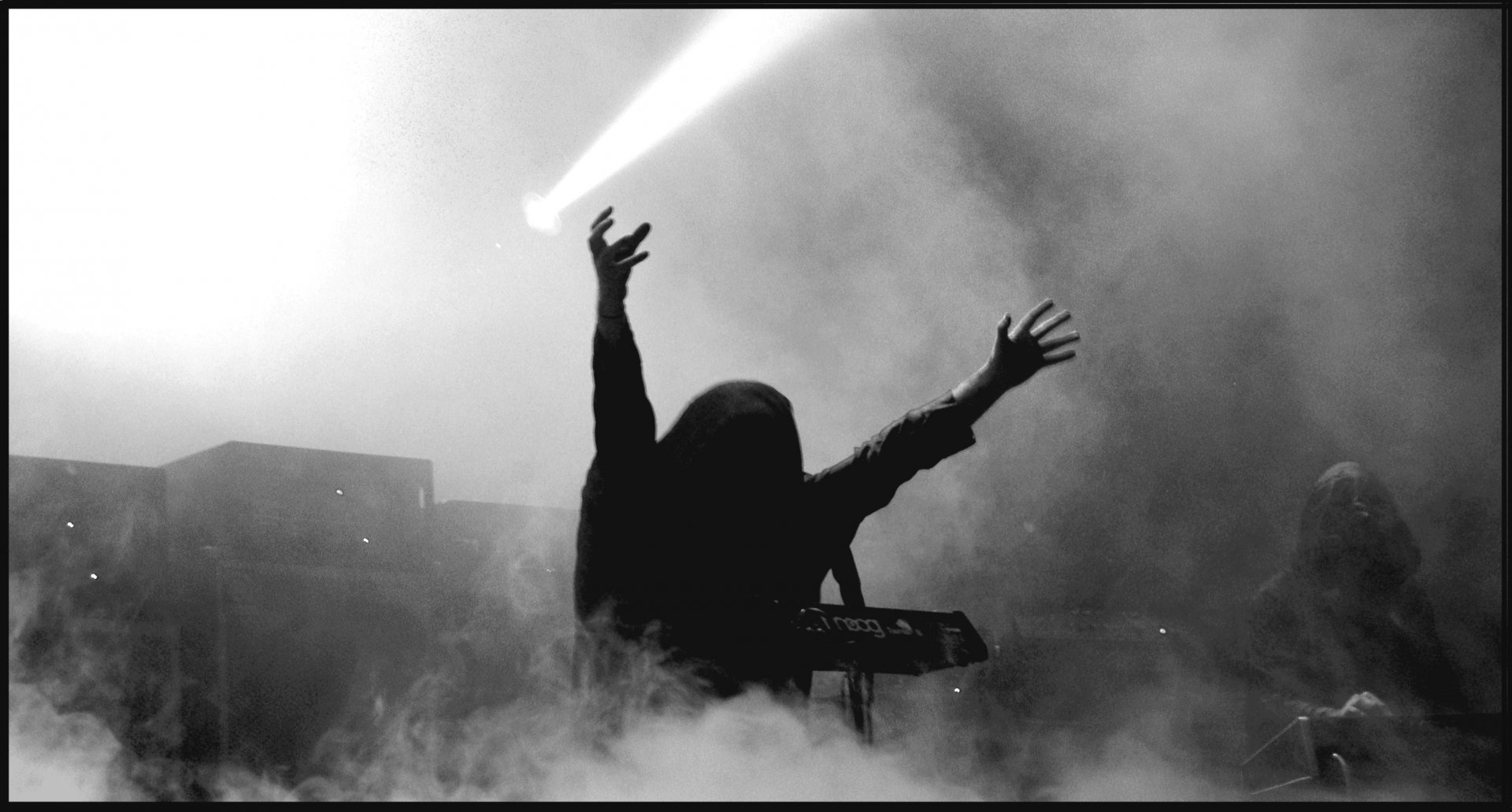
 In 2004 the band also released a split Ep with Earth: Cro-Monolithic Remixes For An Iron Age, remixes of tracks aimed at collectors. After the Ep Candlewolf Of The Golden Chalice (2005), a "Peel session" containing just the nearly 20 minutes of the title track, Sunn O))) are finally ready to pull an ambitious work like Black One (2005) out of the hat. Or rather "out of the hood", given that live they wear long black robes that hide their faces, made even more theatrical by the fog pumped out during shows and the punishing volumes they're known to perform at.
The black album is black in many senses: funereal as ever, but also doubly bound to black metal, to the point of sounding like a distilled, atmospheric version of it. The witches'-sabbath mood of the opening "Sin Nanna" sets the right context for "It Took The Night To Believe", an icy black-metal riff dubbed over by the band's classic earth-shaking drone. After a handful of seconds, the monstrous voice of Wrest of the ambient-black-metal band Leviathan comes in, a dying man's lament reciting unsettling phrases. It's pitch-black psychedelia, a black-metal hallucination with no precedent in their discography and few points of comparison anywhere.
"Cursed Realms (Of The Winterdemons)", an Immortal cover, is screamed by Malefic, singer of Xasthur. It's ten minutes of deafening gusts of unearthly noise and annihilating guitar blows. The more traditional (by their standards) "Orthodox Caveman" and "CandleGoat" make you fear the experimental drive has run dry, an impression that "Cry For The Weeper" shakes with atmospheric keyboards and sinister tolling bells.
Closing the album is what might be the masterpiece of their entire career, "Báthory Erzsébet". The track, a tribute to Bathory and to black metal's most beloved countess, unfolds over 16 minutes a slow rhythm bordering on infrasound, pairing it with tubular bells and then, finally, bringing in the usual distorted guitars. It's a release from the numbing funereal mood, a leap to the heart that is then caged in the blackest anguish by Malefic's voice, which seems to come from beyond the grave, as the liner notes state. This séance, this nightmare vision from the afterlife, is the distillation of thirty years of black metal and doom metal, one of the most chilling tracks the metal world has ever produced.
The richness of Black One, at least of its major compositions, is only partly down to the founding core of Sunn O))). Besides the aforementioned singers borrowed from the black-metal world, a key role is played by two multi-instrumentalists: Oren Ambarchi and Mathias Schneeberger. Alongside them is a smaller electronic contribution from John Wiese (already of Bastard Noise and Sissy Spacek). Once a duo, Sunn O))) have become a project open to outside collaborations that deeply reshape their sound. Black One thus becomes the start of a new career for the band, finally freed from the repetitive, monolithic style of their early days.
A period of major collaborations begins. The split album Angel Coma (2006) features one composition from Sunn O))) and one from Earth. Our heroes' contribution, "Coma Mirror", is a long nightmare that, starting from their distilled black metal, eventually sinks into an eardrum-shattering wall of noise. It doesn't add much to the heights of Black One, but it shows an even closer bond with Dylan Carlson, who would indeed be a regular presence in the lineup going forward.
 More interesting for the band's history is the collaborative album Altar (2006), made with the champions of Japanese metal avant-garde, the formidable Boris (who took their name from a Melvins song — talk about an influential band). The presence of the Far Eastern band gives the sound a feel closer to a canonical rock lineup, bringing back drums, albeit in an expressionistic rather than rhythmic role, and bass. The guitars remain the undisputed rulers regardless, not least because there are now a full four of them on opener "Etna". Far more surprising is "The Sinking Belle", a resigned folk-rock ballad sighed by Jesse Sykes, already active with Sweet Hereafter, a ballad in the half-light that has nothing to do with either headlining band's discography.
The pause, however, is entirely temporary: the galactic drone of "Akuma No Kuma", with vocoder, trombone, synth and moog, lands not far from where the future Fuck Buttons would end up. "Fried Eagle Mind" eases the tension into a gloomy lullaby steeped in reverb and scarred by the most atrocious noise, so much so that "Blood Swamp" closes things out with the most anguished of hallucinated stases, a torment in which guitar howls and moans form an unearthly chorus of the damned.
The limited edition of the album also includes "Her Lips Were Wet With Venom", 28 minutes in the company of, among others, Dylan Carlson. It's a boundless multi-headed monster of guitars, in which the Earth founder plays the role of desert poet, making his instrument ring out in a landscape alien to any form of life.
The 2007 Ep Oracle contains just two compositions, as ever, mammoth in length. Both are tied to a collaboration with sculptor Banks Violette, who turned the band into statues for an exhibition in London. The first, "Belülrol Pusztít", is for pneumatic drill and monstrous voices, laid over the usual mournful drones. "Orakulum", after a few introductory minutes, reveals its nature as a dark ritual, halfway between Tibetan chant, forbidden prayers and invocations to Lovecraftian outer gods.
In the limited edition, the tracklist is rounded out by the sprawling "Helio)))sophist", over 46 minutes long: a collage of some of the band's European performances that seems tailor-made for completists.
 The sixth album, Monoliths & Dimensions (2009), is a worthy follow-up to Black One. Not only does it manage to breathe new life into the band's drones, it also carries forward their collaborative approach, bringing in voice and instrumental contributions from several heavyweight artists: the beloved Dylan Carlson of Earth, the now-trusted Oren Ambarchi, composer Eyvind Kang, the infernal pipes of Attila Csihar, and two trombonists, Julian Priester and Stuart Dempster. As if that weren't enough, the record is dotted with strings, brass, harps, flutes, horns, piano, reed instruments and even a Viennese female choir led by Jessika Kenney.
The album consists of four tracks with the usual gargantuan proportions. "Aghartha" (seventeen and a half minutes) gives the soul time to adjust to the darkness, descending into the pitch-black lake of distortion and drone. Attila Csihar's dirge-like voice arrives to recite the threnody with impassive funereal spirit, injecting tension with the support of the newly expanded instrumentation. By the ninth minute it's already a sinister, deafening symphony; by the tenth, an unbearable swarm of anguished strings and tormented horns; by the eleventh, creaks and funereal tolling are added, before the piano is handed the ritual's scepter, led onward by mournful thuds. Stripped down, this liturgical music reorganizes its own debris as the voice, slow and cavernous, keeps reciting with terrifying persistence, wrapped in tormented horns. Slowly, very slowly, the sound of water rises out of the destruction, and little by little the trombones modulate an om, before leaving the voice alone in the most desolate void.
"Big Church [Megszentségteleníthetetlenségeskedéseitekért]" (nearly 10 minutes) opens with a female choir introducing the catacomb-like drones, destined to merge into a total, almost metaphysical oxymoron: the choir of human voices trembling with emotion battling the inhuman, boundless growl of the guitars. Completing the already rich picture is a prayer delivered like something out of a séance, recited with hypnotic conviction. The track works right through to the end, fueling these shifts and overlaps, suggesting a philosophical reading: the torment of the soul (the female choirs) interprets the violence of nature (the deafening drones) through a liturgical ritual (the esoteric, possessed-sounding prayers). In any case, what's clear is an exaltation of the most ritualistic and spiritual side of the band, expressed with rare creativity.
"Hunting & Gathering (Cydonia)" recaptures the black-metal aura of Black One, this time with more dynamic guitars accompanying the monstrous spoken-word parts, before transfiguring into mournful choirs and, above all, a triumph of the most spectral horns, eventually joined by cosmic synthesizer touches. It closes on eternal oms left floating in the shattered cosmos.
Crowning the record, "Alice" (16 minutes) abandons the deafening, numbing drone for reverberating picked guitar, recalling precisely the Earth of that period, more human and atmospheric. A very slow guitar melody conveys a sense of time, emerging in the silence barely disturbed by the telluric bass, taking on orchestral flourishes. Slowly the composition takes shape, becoming almost epic in its majestic slowness: brass appears to reinforce the slow-motion ascension, the air clears until it brushes against orchestral jazz with harp and bursts of strings. In this sense, it's easy to understand the title's dedication to Alice Coltrane and her spiritual jazz, but the path the composition takes is totally unexpected: "Alice" marks the atonement for the boundless pain and anguish of an entire discography, the gentle arrival at melancholic hope, the moving vision of a starry, luminous sky after crossing through the underworld of the soul.
A second period of collaborations then begins. It starts quietly, with a warped cover of Suicide, on Che (2009), a three-track split. The duo's contribution is a collaboration with Pan Sonic, while the other credited names are Alan Vega and Stephen Burroughs. Given the track's brevity, its nature as a cover, and what was about to follow, it's really a detail for collectors.
Already more substantial is the collaboration with Nurse With Wound on The Iron Soul Of Nothing (2011), a sort of dark-ambient reinterpretation of ØØVoid, with "Ash On The Trees (The Sudden Ebb Of A Diatribe)" standing out as their most traditional doom, made more inventive by sinister noises and an unexpected moment of cacophony and hallucination.
For the collaboration with the experimental Ulver, titled Terrestrials (2014), the two bands offer three live improvisations. The result is worth much less than the sum of its parts: the opener, "Let There Be Light", evocative as it is with its horns, feels like the prologue to a climax that, even when it arrives, fails to impress either in intensity or originality. "Western Horn" introduces their beloved drones, overlaid with a tragic symphony of anguished strings, but across its ample 9 minutes it never shakes the impression of being merely a sketch. "Eternal Return", melancholic and chamber-like, is instead a composition that fuses drone with post-rock, and thanks to the voice of the excellent Kristoffer Rygg, rises to become a song trembling with emotion.
Also in 2014 comes the most unexpected of their collaborations, with experimental singer-songwriter Scott Walker, for Soused. An impassioned vocal alternates with dronic miasmas and gothic-rock touches on opener "Brando". Surrounded by infernal but also rather static music, Walker seems to lose expressive power on "Herod 2014" and "Lullaby", while on the far more eventful "Bull" the fusion with the black priests of metal seems to yield the most distinctive results, its first half deconstructing gothic-rock.
Despite being an unprecedented fusion, one that does find some connections in the singer-songwriter's recent discography, the album doesn't feel like a peak for either Sunn O))) or Walker.
That the band's artistic journey has reached, or nearly reached, its end is confirmed by their seventh album, Kannon (2015). Markedly shorter, it totals just 33 minutes and three tracks that form a single long composition. The spiritual shading remains very much present, audible from the first part onward, marked by a vocal contribution from Attila Csihar more terrifying than ever, an alien growl on which a new ascension to heaven is built. The second part offers a crescendo of guitar drones challenged by a liturgical choir, while the 11-minute finale avoids flattening itself into endless sustained notes, instead exploding the guitars at mid-frequency while a choir intones a dirge. At the seventh minute, a voice tortured by pain makes room for itself, accompanying the track with its dramatic crescendo to its conclusion, a sharp, deafening feedback.
None of this adds anything to what was already heard on Monoliths & Dimensions; it feels almost like a consolation prize to satisfy fans after six years.
 Life Metal, the eighth album, released early for Record Store Day on 13/4/19, and the band's first with Steve Albini at the controls, arrives in 2019. Among the collaborators are also composer Hildur Guðnadóttir, Tim Midyett, and Anthony Pateras, who plays organ on the track "Troubled Air". Created entirely in analog, with no digital intervention even at the post-production stage, the album signals its main shift right from the title: in the once-funereal shroud, "light" has by now been present for a decade, since the masterpiece Monoliths & Dimensions, but this time it takes on a role that's anything but secondary.
After more than twenty years of experimentation with drone-metal, there's little left for Anderson and O'Malley's project to do to surprise listeners. The choice of analog recording gives this work the quality of a document capturing the band's menacing live power, one more reason to listen to it at the highest possible volume. The four compositions, colossal in scale, have a symphonic aura and developments as majestic as they are captivating. "Between Sleipnir's Breaths" opens with grandiloquence, then a faint voice cuts through the menacing blackness of the arrangement. "Troubled Air" explodes at the start but mutates into a dreamlike, if deafening, symphony, as though night and day, darkness and light, were locked in an unstable balance. The closing "Aurora" and "Novae", 19 and 25 minutes respectively, reaffirm the idea of a drone-metal full of nuance.
The former conceals a slow-motion melody and brightens in its finale to moving effect, a glimmer of light after the long polar night. "Novae" reveals itself from the start as particularly eventful, unusually rhythmic by their standards. The initial tension eases after four anxiety-inducing minutes, and after 13 even the deafening volume gives way to a low vibration, the ghost of a sound that retains its unsettling quality without the physical weight of overwhelming decibels. Slowly the monster gets back on its feet: it stumbles, settles, reduces its roar to a whisper, and finally, with a guitar scream, rises again, stentorian and majestic as ever.
Now masters of a dynamic drone-metal that doesn't shy away from symphonic openings and adventurous compositions, Sunn O))) return without overturning their sound. Fans will be thrilled, because the band is alive and well, but it no longer seems able to chart new paths for the future.
More than a true return, the following Pyroclasts (also 2019) completes what we'd already heard on Life Metal. Same recording sessions, same monolithic approach: 4 long 11-minute compositions, distinguished mainly by the different key indicated in brackets. A quartet of improvised drone-metal exercises, used by the band to round off various days of work. The by-now predictable liturgical, superhuman shades return, grinding away at the listener's eardrums and slowly but inexorably lifting them towards a disembodied dimension: it all starts with the opening "Frost (C)" and arrives at the aptly titled "Ascension (A)", a majestic moment of distorted ecstasy. Along the way, the willing listener can meditate on themselves, on life, on the universe, and perhaps even on Sunn O))) themselves, who evidently have little left to prove to their niche audience and are now free to offer up their drone exercises, their deafening studio routine, as a companion piece to the far more palatable Life Metal.
This renews the conviction already formed with the previous chapter: the band has by now reached a solid, admirable, and probably definitive maturity. It's hard to ask for more from a group that practically founded a new style on its own, pushing it to expressive heights unreachable for most others. Listening to the two works together, in order of release, does let us peek into the creative process that leads from the deafening jam to the fully fledged composition, highlighting both the affinities and the differences between the grinding, distorted meditations presented here and the more measured compositions we'd already digested a few months earlier. Even these mitigating factors, however, aren't enough to make this Pyroclasts anything more than a minor work, intended for completists. The album is dedicated to the memory of Ron Guardipee, Kerstin Daley and Scott Walker.

In these years of lesser inspiration, Stephen O'Malley pursues a parallel activity that is often more creative and original than anything released under the Sunn O))) name.
To give an idea of just how varied and challenging this body of sound can be, among his earliest solo releases we find a collaboration with Stefan "Z'EV" Weisser, who takes a recording of O'Malley's guitar and stretches it out into a dark-ambient experiment on Magistral (2007), while the solo album Salt (2008) consists of a single 74-minute track.
Among O'Malley's many incarnations, some simply hard to track down and best left for the more curious and dedicated reader to discover, one that certainly deserves mention is Shade Themes From Kairos (2014), a strange and unpredictable blend of jazz-drone tribalism, at times deafening and elsewhere almost sacred, built together with Oren Ambarchi and Randall Dunn. If the drawback here is the same one that affects much improvisation-based music — namely wordiness and a lack of compositional direction — this eccentric pairing is still recommended to the more adventurous listeners, provided they're armed with a good dose of patience. "Circumstances Of Faith" recalls the ultra-psychedelia of Acid Mothers Temple, with its heavy doses of noise and psychedelia. "Ebony Pagoda", on the other hand, is the track closest to Sunn O))), but with greater dynamics and subtle shades that add important detail to the anguished drone-metal.
Also notable is Cylene (2019), made with François J. Bonnet, which transforms the wall of deafening drones into a poetic threnody, a sorrowful, whispered dance unfolding across moving extended compositions such as "Pāhoehoe", "Erosion Always Wins" and "Des pas dans les cendres". This elusive music feels like the sonic transposition of wandering thought, a disembodied suggestion that is nonetheless so easy to recognize: in a sense, it's spiritual music, impalpable and evocative. O'Malley's blunted guitars are honed into something sleeker by François J. Bonnet's excellent work, transformed into an existential, metaphysical soundtrack once again oriented towards eternity.
The two would follow up the project in 2023 with Cylene II, at times leaning more towards the gloomy and unsettling, but still evocative in extended compositions such as "Ghosts Of Precognition".
The live rendering of these years is well summed up on Metta, Benevolence. BBC 6Music: Live On the Invitation Of Mary Anne Hobbs (2021), recorded for a 2019 Halloween special. The first two compositions, a quarter of an hour each, are enriched by the synth and vocal contribution of Anna Von Hausswolff: these are "Pyroclasts F" and, especially, the more subdued "Pyroclasts C#", opened by a long organ threnody. There's also a third track, a huge, visionary version of "Troubled Air" that runs close to 32 minutes and includes a long trombone passage. They sign to Sub Pop and in 2025 release Eternity's Pillars b/w Raise The Chalice & Reverential, a 12" maxi recommended only to completists.
For the self-titled album, their first full-length for Sub Pop, they choose the colossal dimension that suits them best: six extended tracks, including a pair of 18-minute monoliths. Working at the edges of their typical sound, they rebuild their own language in more lyrical, at times even accessible directions, without betraying its foundations.
The undisputed protagonists remain the guitar drones: thunderous, terrifying, boundless. Anyone familiar with the band will find their trademark sound intact and as evocative as ever. On top of these foundations, though, the black priests of metal merge the cinematic cues of Black One with the mystical undercurrent of Monoliths & Dimensions to offer a new way of reading their otherworldly drones. Field recordings and more pronounced melodic elements emerge, even as they remain folded into the band's familiar musical context.
After years of more tired releases, Sunn O))) is a new ritual that extends the liturgy of a band still capable of creative evolution. Nothing here, however, rewrites their role in the darkest, most deafening music of the last few decades. One might call it a rebirth, but, to quote Lovecraft, "That is not dead which can eternal lie." A splendid cover featuring a painting by Mark Rothko.
Add OndaRock to your favorite sources on Google Discover. Don't miss our reviews, milestones and latest news straight in your feed.


