


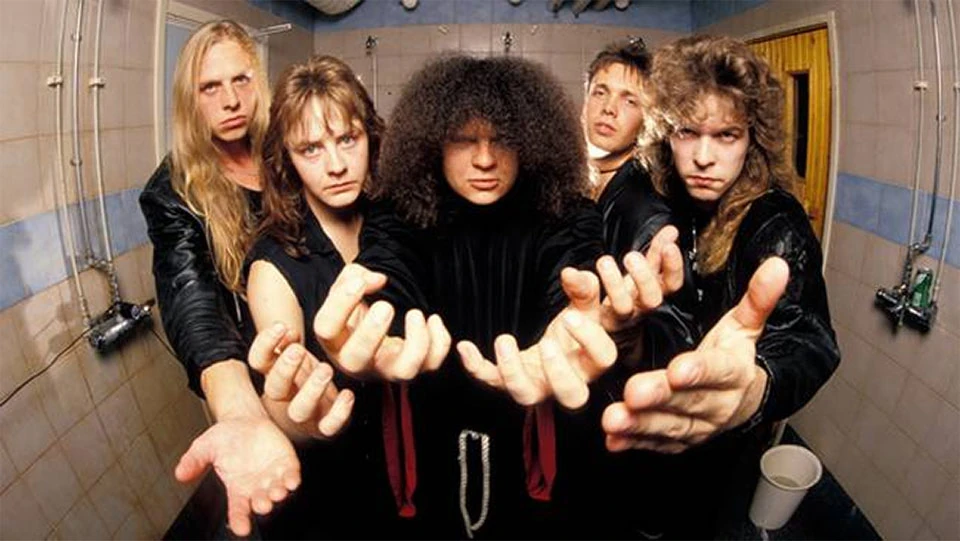
Active since 1984, the Swedish band forged its own brand of epic, nocturnal heavy metal, renewing the vision of Black Sabbath and influencing a generation of doom bands. Across its long career, it has weathered crises and upheavals, carrying on all the way into the 2020s
I’m sitting here alone in darkness, waiting to be free
Lonely and forlorn, I am crying
I long for my time to come, death means just life
Please let me die in solitude
(from “Solitude”)
Sweden's Candlemass, formed in Stockholm in 1984 by bassist Leif Edling, have spent seven lustres staying true to their gothic, doom-laden, epic aesthetic. No small feat, they've managed to do so while achieving solid commercial results, especially at home. As was the case with their forefathers, the beloved Black Sabbath, their long career has been marked by crises, hiatuses and comebacks, which allows us to tell their story by splitting it, more or less naturally, into three chapters.
The first period, between 1984 and 1994, is when they laid the foundations of epic, gothic doom metal, releasing five hugely influential albums for the genre and bringing their music to audiences through lengthy tours. This first decade - and this isn't meant to dismiss the rest of their career - is the one most often referenced by texts covering heavy metal or doom metal, given the impact that Epicus Doomicus Metallicus (1986) and Nightfall (1987) had on the emerging scene at the end of the decade.
Here too, this is inevitably the period that will draw the most attention, as it's what justifies the Swedish band's importance not just within their own stylistic niche, but for the evolution of heavy metal as a whole. The second period, between 1997 and 2002, is marked by a major lineup change and some difficulties in putting albums together. It's a period of crisis, one that inevitably leads to another breakup. On the other hand, it's a pivotal moment for the band's evolution, one that shapes the style of the rest of their career. Had Candlemass found success with a new sound during this brief period, we'd probably be listening to very different albums today. The third and final period, beginning in 2004 and continuing to this day, is one of newfound classic status. Uneven in both lineup and results, it's a long back-and-forth between small changes and callbacks to the past. Largely coinciding with the general decline of heavy metal in particular, and rock in general, in the listening habits of young and old alike worldwide, this latest phase is above all a way of feeding the legend that took shape in that first period. And it's precisely from 1984, and from that cold northern European capital, that we begin to recount the details of this long candle-lit mass.

Behold the sight of my Golgatha
The gallows enlightened by the moon
Proud of his art are the carpenter
His creation, a tool for my doom
(da “At the Gallows End”)
Bassist Leif Edling was part of Nemesis, but when that band split up, he founded his own group, Candlemass, together with singer Johan Längqvist, drummer Matz Ekström and guitarists Mats "Mappe" Björkman and Klas Bergwall. Within a few months - by 1985, in fact - the first songs and the first demo arrived, even though there was no permanent singer in place. Johan Längqvist filled in as best he could, which led to the opportunity to record a proper debut in 1986.
Released just before summer, Epicus Doomicus Metallicus is actually their coldest and most funereal album, steeped in a solemn, depressive grandeur. While the mainstream path of contemporary heavy metal was to play faster, louder and more savage, Candlemass chose to set themselves apart with long, lumbering, viscous songs, sung with operatic, baritone inflections. Rather than drawing on Cold War anxieties, the horrors of human violence, or the most repellent gore, the Swedes wrote a six-song rosary in which not a single ray of light filters through, dealing with an intimate, deep, inescapable malaise.
The opening track, "Solitude", is the ideal manifesto of their approach to music: a suicide note, delivered through a majestic, stentorian, elegant nocturnal heavy metal. "Solitude" is so paradigmatic of their entire career that it has never once been left out of a single Candlemass show: the first chapter of the band's story is, essentially, an exploration of the mindset of a would-be suicide. What's harder to grasp, though, is how the band conveys the relationship between suffering and extreme self-destruction. Though tormented in its morbid, funereal, warped melodies, and though remaining largely suffocating and bleak overall, this epic doom metal - as the mock-Latin title trivially puts it - channels the ambiguous sensuality of death, its liberating, soothing undertone. We are, then, in an entirely different world from the ultra-violent death - perhaps via machine gun or nuclear bomb - imagined and turned into albums by other equally brutal musicians of the era.
The dominant colour of Epicus Doomicus Metallicus isn't the exaggeratedly bright red of splatter cinema, nor the slightly more burnished tone of the "Théâtre du Grand-Guignol", but shades of grey, black and sepia. In its emotional palette, violence is merely a vehicle, never the protagonist or the end goal, while melancholy, disappointment, nostalgia and apathy are far more decisive, central and dominant forces. The other five tracks explore the same tragic emotional state, occasionally flirting with a bit of speed/thrash metal ("Demons Gate"), a particularly exuberant solo ("Crystal Ball", which features a textbook slam-dance moment), or the kind of sectional, compositional structure typical of prog rock ("Black Stone Wielder", "Under The Oak"). The lengthy "A Sorcerer's Pledge" attempts, across its 8 minutes, to bring all these variations together into something like an ideal compendium, even featuring a thriller-style keyboard passage.
Initially the public's response is lukewarm, to the point that the small label "Black Dragon" terminates the contract, discouraged by the rather modest sales. Needless to say, this debut will in time come to be regarded as a milestone of the genre and reissued on multiple occasions, complete with collector's editions, testifying to its status as a cult object. Bands like My Dying Bride, Cathedral and Paradise Lost will often look to these six tracks for inspiration.
Hardly discouraged by the unsatisfying commercial response, and now reorganized with Eddie "Messiah" Marcolin on vocals replacing Johan Längqvist, and armed with a new contract with the label "Axis", Candlemass return at the end of 1987 with Nightfall. Other changes, though less significant than the change of singer, have also been made to the line-up: Jan Lindh is the new drummer and Lars Johansson joins on guitars. Marcolin, however, is the proverbial missing piece of the puzzle, turning this second album into their gothic masterpiece. His operatic baritone is the ideal voice for a slow, lugubrious heavy metal, both majestic and heavy. His influence also leads the band to include, in the track listing, a reworking of Chopin's funeral march, in the name of a refinement that's easier to perceive on Nightfall than on Epicus Doomicus Metallicus.
Greeted with enthusiasm by the specialist press and the public, the album is seen as a synthesis of the proto-doom heavy metal of Black Sabbath and the new era inaugurated by Metallica with their first, exceptional albums. Divided into ten tracks, four of which are brief instrumentals, it's a sort of refined version of the debut and continues to develop mainly through long, tormented compositions.
Opened by the gothic-operatic explosion of "Gothic Stone", the album finds in "The Well Of Souls" its new compositional model, likewise gothic, epic and suffocating. Tracks such as "Codex Gigas", "At The Gallows End" and "Samarithan" reaffirm the idea that Candlemass are an extremization of Black Sabbath, especially the Black Sabbath fascinated by the progressive leanings of "Masters Of Reality", viewed through a much more pronounced gothic-decadent sensibility. More muddled is the operatic thrash-metal of "Dark Are The Veils Of Death", a compromise with the metal more in vogue at the time. Back on track with a classic epic-doom-metal piece like "Bewitched", the Swedes close out the record by reaffirming their stable position on the throne of the style they themselves christened.
Ancient Dreams (1988), on the other hand, is a third album that amounts to a confirmation, and little more. The lineup from Nightfall returns and plays the same epic-doom-metal for which it was praised by fans, pushing the spectacular side of its sound even further. Marcolin in particular often verges on the most exalted histrionics, drawing comparisons to Bruce Dickinson and Rob Halford, and overall the band leans more heavily on solos ("A Cry From The Crypt", "Darkness In Paradise", "Ancient Dreams"), deafening volumes and speed-thrash outbursts ("The Bells Of Acheron").
With "Mirror Mirror" added to their catalogue of classics, little else holds up against the first two albums. The more decadent side of their music around despair returns in "Epistle No. 81". The compact-disc edition even features a Black Sabbath medley, a fitting tribute but also a typical way of padding things out.
The third record, which reaches number 45 on the Swedish album chart, allows the band to also make an appearance on the equivalent American chart.
The fourth LP, Tales Of Creation (1989), already attempts to recapture the sound of their early days, with "Dark Reflections", "Into The Unfathomed Tower" (an entirely instrumental speed-metal track!), "Somewhere In Nowhere" and "A Tale Of Creation", which are reworkings of older songs. "Under The Oak" is simply the track from the debut, re-recorded with Marcolin. With shorter songs that still don't shy away from the more spectacular moments, Candlemass bring to a close what amounts to an ideal tetralogy in which they outlined their own particular way of making heavy metal.
It's no small detail that Marcolin himself, the man who helped crystallize their epic doom into a recognizable format, would not take part in the band's work again for a full 15 years; in 1991, following a long tour also documented on Live (1990), he leaves the band.
The others don't last much longer. They release Chapter VI (1992), with Thomas Vikström on vocals, but the commercial results are modest and shortly after the band decides to split up. The fact that Edling had also started a side project, called Abstrakt Algebra, reveals the band's need to break out of the substantial monotony in which it had become trapped.
Even considering the album as belonging to the band's history in name only, Chapter VI comes away labelled as a heavy metal record that mixes doom with the English school, without holding up against the drive toward contamination and extremization found in many contemporary bands: it's a work that belongs more to the '80s than the '90s.
On the EP Sjunger Sigge Fürst they even sound outright silly, in a parody of pop-rock that frankly undermines all their credibility.
This marks the end of the first era in the long career of the Swedish band. With Edling busy elsewhere, a highly charismatic singer gone from the lineup and few new ideas left to develop, after 5 studio albums and a live document, and after years of grueling touring, Candlemass seem to have reached the end of the road: the would-be suicide of "Solitude" finally meets the long-contemplated death. At least, everything would seem to suggest that the end has come, but fate is unpredictable, and what looks like a tombstone turns out to be simply a long pause.
As the black god arises from the cold of the lake
Figure of smoke, emerald head
Magnificent is the king of the dead
(from “Tot”)
Disappointed with his new project, the bassist and Candlemass leader decides to reuse some tracks originally intended for Abstrakt Algebra in order to reform the band. After all, it's the label, Music For Nations, asking him to cash in on the cult name's pull, and the continuity with the past is underlined even by the cover art, which clearly references the debut, with its skull pierced by a cross.
The record is, in short, ill-conceived: begun with Abstrakt Algebra's progressive sound, it was reshaped to fit the epic doom-metal sound of Candlemass. What's more, far too many musicians take part in the recording sessions, which stretch out over a full 18 months of work. The result is a hybrid of the classic sound (“I Still See The Black”, “Karthago”), stoner-rock (“Wiz”), and the most hallucinated space-rock (“Dustflow”, “Abstrakt Sun”).
Dactylis Glomerata (1998) is therefore a sort of apocryphal sixth album. Unlike its predecessor, it's firmly rooted in its era, particularly in that moment of self-reflection that heavy metal underwent at the turn of the millennium: part tradition, part contamination, a bit alternative and a bit trendy. The band is clearly at ease with the anguished miasmas favoured by the new generation, which they interpret effectively on the tense “Apathy”, and on the nocturnal, jazzy “Thirst”.
Closing out the millennium comes From The 13th Sun ('99), an album dedicated to Black Sabbath, whom the Swedes consider “the greatest band of all time”. Unsurprisingly, it's a return to roots and, if anything, a recovery of blues-rock fascinations that had never before been made so explicit, now emerging after the stoner-rock detour of the previous album. Even more than the debut, this is an album that closely studies the early, memorable work of Ozzy Osbourne and co. “Tot”, to cite one representative track among many, replicates “Black Sabbath” itself almost to the point of mere imitation, with the same bells and the same dynamics. Modernity only creeps in through the fat, earth-shaking sound that occasionally pummels the drums, for instance on “Elephant Star” which, in essence, is a reworking of “Symptom Of The Universe”.
Having reached a new moment of stasis, the Swedes take stock of this second chapter of their career with Doomed For Live – Reunion 2002 (2003), with Messiah Marcolin back on vocals. It's a parade of classics that reaffirms the band's legacy, but which nonetheless once again suggests their career might be nearing its end. Once more, though, death fascinates the band without claiming them. Edling in the meantime busies himself with Krux, while much of the catalogue is reissued in remastered form. The reunited band struggles to deliver a new album, a worthy successor to Tales From Creation, and indeed ends up bickering. For two years, Candlemass cease to exist.
The stars will drop from the sky
The gods will mourn me and cry
If I ever die
(from “If I Ever Die”)
The band's final period is one in which its members come to accept that they can't surpass their early albums. It unfolds over a good decade and a half, and could potentially continue right up to Edling's retirement from the scene. When this third phase begins, with Candlemass (2005, a programmatic title), Marcolin is still on vocals. Having abandoned their flirtations with alt-metal, stoner and psych-rock, the band returns to their paradigmatic epic doom-metal, almost as if twenty years of music hadn't passed under the bridge. Cohesive in style, strong in the form of a now-undeniable maturity, this eighth album finally hands the band the key to success. Climbing all the way to number 7 on the Swedish Albums Chart, the highest position reached in their entire career, Candlemass unexpectedly become one of Sweden's most celebrated bands. Never mind that in 2007 Marcolin again parts ways with the band — by now they've become an unstoppable doom-machine.
Robert Lowe, previously of Solitude Aeturnus, steps in on vocals, in time to complete the ninth album, King Of The Grey Islands (2007). A record charged with an enviable energy, given the musicians' age, but one that doesn't seem destined to leave much of a mark on doom-metal history.
The tenth album, Death Magic Doom (2009), of which the same can be said, opens with the charging “If I Ever Die”, in contrast with the suicide-note mood of “Solitude”: depression has become a style, a constant aesthetic the band has codified within heavy metal. If nothing else, this album marks a peak for singer Lowe, who gets to display all his talents as a latter-day Ronnie James Dio, on a work that, rather than reinventing doom-metal, simply delivers it through tracks in line with the classics, with a few moments of striking immediacy.
Its successor, however, is slow in coming, with the wait filled in by a collection of rarities for completists titled Doomology (2010): initially expected in 2011, then pushed to the following year, it's finally released only in June of that year, through Napalm Records. It's called Psalms For The Dead (2012), and it's announced as Edling's career-closing album — barring a predictable change of heart afterward. It contains further tracks in line with the band's classic style, including their cover of “Electric Funeral” by, once again, Black Sabbath, which seems to be the inspiration behind “Waterwitch”.
It is, in any case, the last album with Lowe on vocals, who leaves six days before its release. The reason has to do with underwhelming live performances from that period. Stepping in to replace him is an old friend and collaborator of the band, Mats Levén, formerly of Yngwie Malmsteen's Therion, as well as Treat and At Vance.
With their career virtually over, in 2013 Candlemass were named by hard-rock magazine Sweden Rock Magazine as the greatest Swedish hard-rock/metal band of all time. A concert with none other than Entombed followed, as did a headlining slot at the Väsby Rock Festival.
After celebrating their thirtieth anniversary with the EP Death Thy Lover (2016), followed by another EP, House Of Doom (2018), in 2018 even Johan Langquist returned to the fold, 32 years after singing on what has since become a legendary debut. Featuring an appearance by none other than Tony Iommi on "Astrolus – The Great Octopus", The Door To Doom (2019) carries the band to the edge of the 2020s, extending their career once again and reaching number 13 on the Swedish album chart and number 18 in Germany. Strong results in Switzerland, Austria, Scotland and Belgium too confirm the prominent standing the band has by now firmly earned across Europe.
To mark the start of the new decade comes the EP The Pendulum (2020), six tracks but just twenty minutes in total. Essentially, these are the leftovers from the previous album, offered up to a particularly devoted fanbase, by now ready to listen to any new release from a legendary doom-metal band. It's probably the same audience targeted by the thirteenth album, Sweet Evil Sun (2022), which sticks to well-worn formulas without any real novelty. The most creativity they allow themselves is ranging across various takes on the same sound: a dark, obsessively repeating riff ("Wizard Of The Vortex", "Angel Battle", "Goddess"); a dramatic vocal melody seasoned with a solo harking back to heavy metal tradition ("Sweet Evil Sun", "Black Butterfly"); a burst of speed that doubles the tempo and shakes off the gloomy torpor of the tracklist ("Crucified"); or, again, a pain that turns anguished and wraps itself in romanticism ("When Death Sighs").
On "Devil Voodoo" they attempt a less straightforward composition, opting for the well-known model in which an acoustic intro gives way to a galloping charge, as taught by Iron Maiden 40 years ago. In the end, though, the track that deserves to be remembered is "Scandinavian Gods", because, despite sticking to the classic formula, it surpasses the others in intensity. For completists and fans only.

Add OndaRock to your favorite sources on Google Discover. Don't miss our reviews, milestones and latest news straight in your feed.
This article is an English translation of the original Italian text, published on OndaRock.it. It was translated with the help of artificial intelligence, under the editorial responsibility of OndaRock's editor-in-chief, Claudio Fabretti.
| Epicus Doomicus Metallicus (Black Dragon, 1986) |  |
|
| Nightfall (Axis, 1987) | |
|
| Ancient Dreams (Enigma/Metal Blade, 1988) | ||
| Tales Of Creation (Enigma/Metal Blade, 1989) | ||
| Live (live, Metal Blade, 1990) | ||
| Chapter VI (Music For Nations, 1992) | ||
| Dactylis Glomerata (Music For Nations, 1998) | ||
| From The 13th Sun (Music For Nations, 1999) | ||
| Doomed for Live – Reunion 2002 (live, Powerline, 2003) | ||
| Candlemass (Nuclear Blast, 2005) | ||
| King Of The Grey Islands (Nuclear Blast, 2007) | ||
| Death Magic Doom (Nuclear Blast, 2009) | ||
| Pslams For The Dead (Napalm, 2012) | ||
| The Door To Doom (Napalm, 2019) | ||
| Sweet Evil Sun (Napalm, 2022) |
 MilestoneRecommended by OR


