


The story of a group that changed Latin rap, singing about the streets, guns and marijuana
Some musical revolutions emerge from a dense, intoxicating haze of smoke, imposing new aesthetic coordinates through a sound that is at once claustrophobic, hallucinated and innovative.
When Cypress Hill first appeared at the dawn of the Nineties, Californian hip-hop was deeply coded by the street narratives of gangsta rap from names like Ice-T, NWA and Tupac, but the collective formed in South Gate upended some of those dogmas, introducing a brand-new urban grammar: a dark hybrid in which Hispanic roots, B-Real's exasperating and hypnotic nasal timbre, Sen Dog's hardcore drive and the dusty, stoned beats shaped by DJ Muggs converged into a hallucinated, hypnotic formula flexible enough to cross-pollinate with echoes of psychedelic rock as well as with the contemporary trip-hop scene.
This musical anomaly didn't just legitimize the militant use of Spanglish in American rap and carry anti-prohibitionist rhetoric into hip-hop culture, but also built a bridge between street culture and other sonic worlds, contributing significantly to the crossover sound that bridged the two millennia.

Cypress Hill are a hip-hop group formed in South Gate, California, in 1988. The original lineup, initially called DVX, or Devastating Vocal Excellence, was made up of Cuban-American brothers Senen Reyes, known as Sen Dog, and Ulpiano Sergio Reyes, aka Mellow Man Ace, alongside New Yorker Lawrence "DJ Muggs" Muggerud and Los Angeles native Louis "B-Real" Freese, of Mexican and Afro-Cuban descent. After Mellow Man Ace left to pursue a solo career, the group took the name Cypress Hill, inspired by the street of the same name in their hometown, and B-Real developed his signature nasal, high-pitched vocal style to stand out within the scene, despite the skepticism of DJ Muggs and Sen Dog. In fact, it instantly became an all-important trademark. While Sen Dog has a more aggressive, traditional delivery, often shouted, B-Real blends the cartoonish flair of Slick Rick with the haze of marijuana, another central element of their whole aesthetic. This contrast between a more typically street-style rap and a hallucinated dimension is made possible by DJ Muggs's beats, woven from samples more traditionally tied to the hip-hop world, hence soul-jazz-funk, with fragments from musicians such as Jimi Hendrix, Iron Butterfly or Black Sabbath.
In 1989 they recorded a demo that landed them a record deal with Ruffhouse Records. In August 1991 they released their debut album, Cypress Hill, from which they drew their first hit singles. It's a watershed moment in hip-hop history, opening a new front for southern hip-hop and for the West Coast. Latin rap had already been inaugurated by The Mean Machine with their 1981 single "Disco Dream", but Cypress Hill turned it into a central phenomenon of the Californian scene, which was, at the time, one of hip-hop's two world poles alongside New York.
An electric guitar drives the opening "Pigs", a frontal assault on the police that echoes NWA's "Fuck The Police" and effectively introduces the group's language: a hypnotic beat, a loose, rolling groove, B-Real's nasal timbre front and center at the mic. Public Enemy seem instead to be the inspiration behind other tracks, such as "How I Could Just Kill A Man" and "The Phuncky Feel One", closer to the Eighties model, aggressive and fast, built around a chorus made for shouting along: two of their classics, even if not especially representative of the style they'd develop from the second album onward.
A funk-guitar loop spins hypnotically on "Hole In The Head", a psychedelic, chicano take on Slick Rick, while "Psycobetabuckdown" pushes toward an intensity that closely recalls the funk-rock of fellow Angelenos Red Hot Chili Peppers.
The centrality of marijuana culture, which would become fundamental to their identity, surfaces in the hazy "Stoned Is The Way Of The Walk", while "Latin Lingo" sounds like a manifesto for Spanglish-speaking latin rap, slowed down and wrapped in cannabis smoke.
The album would sell two million copies in the US alone, reaching #31 on the Billboard 200 and earning double-platinum certification from the RIAA. "How I Could Just Kill A Man", their biggest hit single, would peak at #77 on the Billboard Hot 100. It was later named by US hip-hop bible The Source as one of the 100 best rap albums of all time. And yet Cypress Hill still carries some rough edges.
In 1992 their songs appeared on several film soundtracks: "Shoot 'Em Up" in Juice, "Latin Lingo" in Lethal Weapon 3 and "A To The K" (later included on their second album) in White Men Can't Jump. That same year they played the Lollapalooza festival and toured with the Beastie Boys.

Their second album, Black Sunday, arrived in 1993, debuting at #1 on the Billboard 200. It sold 261,000 copies in its first week, a record at the time for a hip-hop album. It would go on to reach quadruple-platinum status at home, also performing strongly in Canada and the UK.
If Cypress Hill had been a national success, Black Sunday placed the band among rap's international heavyweights.
The commercial success was driven by the single "Insane In The Brain", which reached #19 on the Billboard Hot 100, #16 on Dance Club Songs, #1 on Hot Rap Tracks, and earned the group its first Grammy nomination: an irresistible hook, tailor-made for the locotes of latin rap.
The main reason Black Sunday surpasses the debut is probably down to DJ Muggs, who broke much more decisively from Eighties-style production to carve out his own path of dreamlike, hypnotic, thoroughly hallucinated beats, often tinged with murky, gothic atmospheres. Within this marijuana-smoke-filled sonic context, B-Real's voice becomes a psychedelic, unreal, dazed guide. The peak of this new style opens the album: "I Wanna Get High" is a stoned, staggering dream that takes shape out of a cloud of smoke it returns to by the end of its brief three minutes.
The aggressive "I Ain't Goin' Out Like That" pushes toward Bomb Squad-style big beat, even sampling Black Sabbath, territory also touched by "Lick A Shot" and the explosive closer "Break 'Em Off Some". Gangsta rap merges with Jamaican toasting on "Cock The Hammer" and becomes an unsettling bilingual fairy tale on "3 Lil' Putos".
Drug use quickly became an obsession running through their work, with frequent references in the lyrics and songs tailor-made for stoner subculture like "Hits From The Bong". Their other fixation is firearms, as shown by "A To The K" and "Hand On The Glock".
While its darker, more aggressive side also won the group a following among metal fans in search of fresh influences and cross-pollination — complete with a sample of "Lick A Shot" on Korn's debut single "Blind" — their embrace of cannabis subculture also placed Cypress Hill within another major youth subculture. The vehicle is a mixed-race hip-hop, both because it's often bilingual and because it's open to rock influences far removed from the genre's usual touchstones. Black Sunday thus turned Cypress Hill into a gateway to hip-hop for a whole new audience (often, and gladly, a white one).
Intense touring activity went hand in hand with new film tie-ins, this time for the 1993 movie Cuba libre – La notte del giudizio, an experience that brought them even closer to a rock audience through collaborations with Pearl Jam and Sonic Youth.
On October 2, 1993, during an appearance on Saturday Night Live, DJ Muggs smoked a marijuana joint live on air despite network bans, resulting in the group's permanent ban from future NBC broadcasts: just another way to enter music legend, one of those anecdotes that cemented their place in cannabis subculture.
During their performance at Woodstock '94, percussionist Eric Bobo officially became a member of the group. In 1995 they released their third studio album, III: Temples Of Boom, which reached #3 on the Billboard 200 and went platinum. It's an album that embraces the darker, more spectral side of their sound, leaning into slow beats and paranoid atmospheres. Once again, it's DJ Muggs who makes the difference, working in tandem with B-Real.
The first half of the album is one continuous latin-rap assault laced with horror-movie touches in the arrangements, anguished tension and narcotic haze. The unreal melody driving "Spark Another Owl" is the skeleton of a new "I Wanna Get High", while "Throw Your Set In The Air" pounds away on a spectral loop and "Stoned Raiders" comes close to outright ghostly.
The sonic choices are by now quite sophisticated, as heard on "Illusions", a psychedelic postcard built around sitar. The cartoonish side has vanished entirely, and now songs like "No Rest For The Wicked", "Killafornia", "Let It Rain" and "Killa Hill Niggas" (featuring RZA and U-God of the Wu-Tang Clan) reek of death. The tension eases mainly on "Boom Biddy Bye Bye", more dreamy and childlike despite its funereal message.
Clearly success and substance abuse hadn't exactly led to peace of mind: Temples Of Boom is essentially a sonic nightmare, claustrophobic and paranoid, obsessive in its unsettling loops. Far from alienating anyone, though, this was right in line with the rock and metal youth subculture of the period, perfectly attuned to a bleak vision of existence. Its grim imagery dovetailed with the aesthetics of nu metal and the broader crossover world of the mid-Nineties, which happily adopted the band and further broadened their recognition.
It's no accident that within a few years Cypress Hill would partly become a rock band, only to later backtrack and search for the roots of their own sound. Either way, Temples Of Boom closes out the most creative period of their career, the one that serves as the benchmark for the rest of their output, whether by kinship or by contrast.
The question of which album is best among the opening trilogy is clearly much debated, and this writer can't claim to settle once and for all a question that has fascinated listeners for decades. If Cypress Hill is a manifesto of cross-pollination linking the Eighties and Nineties in an innovative way, Black Sunday pushes DJ Muggs's beat experimentation toward a more personal, mature style, placing the band firmly within new youth subcultures. Temples Of Boom exaggerates certain aspects of its predecessor, pushing even further into the mix of smoke, lead and paranoia.
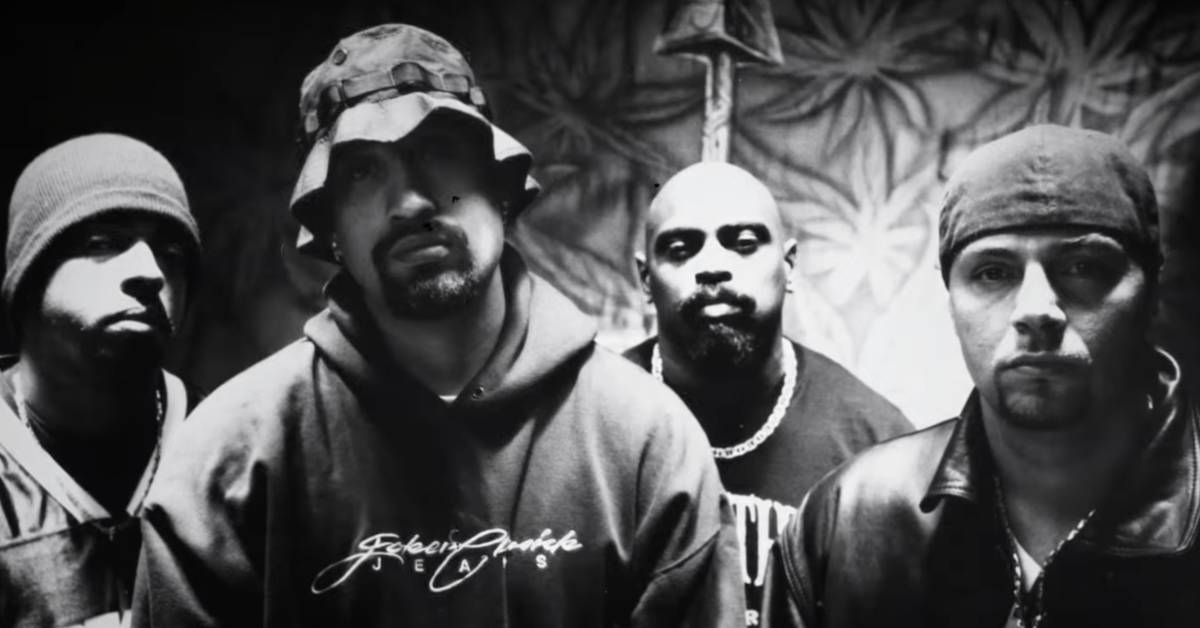
The price to pay for a long stretch of intense musical activity came due: Sen Dog temporarily left the group to form the rock band SX-10. Cypress Hill nonetheless kept touring between 1995 and 1996, backed by various guest vocalists covering his verses. In 1997 the members turned to side projects. Sen Dog rejoined the lineup in early 1998, taking part in the making of IV, released that October, which went gold in the US.
For the first time in their discography, this is an album that largely gives up on renewing their sound, opting instead for a slightly brighter take on Temples Of Boom. There are new moments of acidic, spectral latin hip-hop ("Looking Through The Eye Of A Pig", "Prelude To A Come Up", "Audio X", "Dead Men Tell No Tales"), nods to big beat ("Checkmate"), even more conventional gangsta-rap moments ("From The Window Of My Room").
"Tequila Sunrise" (feat. Barron Ricks) is the key moment for their bilingual side, a chicano rap that reinforces their role as a bridge between two different audiences, while "Dr. Greenthumb" is another festive anthem for marijuana smokers.
"Lightning Strikes" brings in a metal-leaning electric guitar that confirms a renewed, somewhat naive interest in a hip-hop/rock hybrid formula: menacing riffs over which they rattle off rap verses that aren't especially inspired, falling in line with nu metal without any particular spark. Unfortunately, this would become one of the main directions Cypress Hill pursued in the years to come.
IV sounds like a transitional album from a group that no longer knows which way to turn. Confirming as much is the compilation Los Grandes Éxitos En Español (1999), reworking their hits in Spanish.
In 2000 they released Skull & Bones, an album split in two: one rap disc and one rock disc. The lead single was even released in two versions: "(Rock) Superstar", featuring Eminem, and "(Rap) Superstar", featuring Chino Moreno of the Deftones.
The hip-hop side is often far removed from the hypnotic, evocative blend of old, closer to an aggressive and fundamentally unremarkable style typical of the Eminem/Dr. Dre era. "Stank Ass Hoe" and "Certified Bomb" are fun but easily forgettable episodes, with DJ Muggs in particular seeming to have lost his old personal touch.
The rock side opens with the distorted blows of "Valley Of Chrome", a rap-metal track alternating quiet and loud passages, flattening the lesson of Rage Against The Machine into the most predictable nu metal of the period. One can admire the intent to merge different musical worlds, but otherwise tracks like "Get Out Of My Head", "Can't Get The Best Of Me", "A Man" and "Dust" sound naive and poorly blended.
Next came the live album Live At The Fillmore (2000), recorded in San Francisco, and the studio record Stoned Raiders in 2001, which stalled at number 64 on the Billboard 200: the creative crisis had by now become a full-blown commercial crisis.
Their rap-metal is actually sharper than before, as shown by the single "Trouble", and the hip-hop side remains enjoyable, confirmed by "Kronologik" with Kurupt and especially by the party-ready latin-rap of "Lowrider", with its high-pitched Dr. Dre-style synths. They also attempt a curious soul-rap blend on "Bitter", a preview of future noir solutions. What's been lost is personality: "Amplified" and "Catastrophe" could pass for subpar Papa Roach songs; "It Ain't Easy" sounds like a Kid Rock single; "Memories" like a Snoop Dogg outtake. You have to settle for the spectral, cartoonish nursery rhyme of "L.I.F.E." featuring Kokane to relive a bit of the old magic.
In 2004 Cypress Hill released Till Death Do Us Part, a work influenced by reggae sounds and driven by the single "What's Your Number?", featuring Tim Armstrong of Rancid. For the most part they keep practicing a rap-metal that's quickly becoming dated, as on "Another Body Drops", while trying to evoke their old dark style on "Till Death Comes" or "Never Know" and adding latin-rap tracks to the songbook with "Latin Thugs" alongside Tego Calderón. At least there's some fun to be had on "Ganja Bus" — a lively, danceable track with famous offspring Damian Marley — and they attempt a gloomy, smoky jazz-rap on "One Last Cigarette", dominated by vibraphone.
Afterwards, DJ Muggs takes a break from the group, and the band's output continues with the compilation Greatest Hits From The Bong in 2005. Among the little worth noting is a reggaeton remix of "Latin Thugs".
Sony squeezes Cypress Hill for all it's worth in the following years: Super Hits (2008) is another compilation, with lyrics stripped of explicit content; Collections, from the same year, is a superfluous addition to the catalog; Strictly Hip Hop: The Best Of Cypress Hill, from 2010, is a more substantial double compilation. These releases symbolically close out a difficult period in the band's career and set the stage for a comeback with a new studio album. A further compilation wouldn't arrive until 2014, The Essential.

The eighth album, Rise Up, came out in April 2010 on Priority Records under the creative direction of Snoop Dogg; the record, which reached number nineteen on the Billboard 200, features numerous guests including Tom Morello and Marc Anthony, while DJ Muggs's production is limited to just two tracks. It's unclear what's left of Cypress Hill beyond the name on the cover: it sounds like an album by imitators, one that genuinely risks ending the band's career.
A follow-up wouldn't arrive until as late as 2018, the year that saw the release of the surprising Elephants On Acid, marking DJ Muggs's return as the band's principal composer and producer: while commercial success still proves elusive, on a creative level it's something of a minor miracle, breathing new life into a tired formula. Built using Middle Eastern and psychedelic sounds, partly the result of the producer's travels to Egypt and Jordan, it's an album wrapped in dense mists and evocative scents.
The Eastern-tinged psychedelia of "Band Of Gypsies", the hallucinated, distorted gangsta-rap of "Put Em In The Ground" and the liquid "Jesus Was A Stoner" introduce a new vocabulary, one in which the production transforms the original hip-hop until it's almost unrecognizable.
New stoner anthems like "Oh Na Na" and "Reefer Man" and latin-rap statements like "Locos" sit alongside the distorted, obsessive bass of "Falling Down" and the circus-like moment of "Crazy". After years of predictable songs, Cypress Hill, and Muggs above all, have rediscovered their creative spark and seem to have shed a solid twenty years.
In April 2019 Cypress Hill were awarded a star on the Hollywood Walk of Fame, becoming the first hip-hop group to receive such an honor. In March 2022 they released their tenth album Back In Black, produced entirely by Black Milk with no contribution from DJ Muggs. It's the first record of their career not to chart on the Billboard 200. Presented as the likely final chapter of their discography, it's a return to a generic sound that struggles to engage with their classics, falling into self-imitation. A rather unglorious chapter for a band that helped shape the history of hip-hop.
In July 2024 the group performed at the Royal Albert Hall in London backed by the London Symphony Orchestra, making real a 1996 sketch from "The Simpsons".
At the start of 2026 the release of their eleventh studio album, titled Dios Bendiga, was officially announced. The record, sung entirely in Spanish and produced by DJ Flict, was scheduled for July 24, 2026. 35 years after their debut, Cypress Hill cash in their credit with latin hip-hop through an album of reassurances, self-celebratory and capable of entertaining at its best moments. It lacks the creative vision of their classics, but on the other hand it manages to bring into focus a part of their hip-hop aesthetic that was otherwise missing a proper testament. Perhaps, though, it's really time to bid their audience farewell with dignity. The group has planned one further, definitive studio reunion with DJ Muggs to record what has (once again) been announced as the final album of their long career.
Add OndaRock to your favorite sources on Google Discover. Don't miss our reviews, milestones and latest news straight in your feed.
| Cypress Hill (Ruffhouse, Columbia, 1991) |  |
|
| Black Sunday (Ruffhouse, Columbia, 1993) | |
|
| Cypress Hill III: Temples Of Boom (Ruffhouse, Columbia, 1995) | |
|
| Cypress Hill IV (Ruffhouse, Columbia, 1998) | ||
| Los grandes éxitos en español (Ruffhouse, Columbia, 1999) | ||
| Skull & Bones (Columbia, 2000) | ||
| Live At The Fillmore (Columbia, 2000) | ||
| Stoned Raiders (Columbia, 2001) | ||
| Till Death Do Us Part (Columbia, 2004) | ||
| Greatest Hits From The Bong (Columbia, 2005) | ||
| Super Hits (Sony, 2008) | ||
| Collections (Sony, 2008) | ||
| Rise Up (Priority, EMI, 2010) | ||
| Strictly Hip Hop: The Best Of Cypress Hill (Sony, 2010) | ||
| The Essential Cypress Hill (Sony, Legacy, 2014) | ||
| Elephants On Acid (BMG, 2018) | |
|
| Back In Black (MNRK, 2022) | ||
| Dios bendiga (Self-released, 2026) |
 MilestoneRecommended by OR


