


Mike Skinner transformed English rap, upending Anglo hip-hop and pointing the way to grime and its alternative fringes through his "pirate material".
Michael Geoffrey Skinner, born in the northern suburbs of London and raised in Birmingham, is not the first English rapper — in fact Anglo hip-hop has had its own tradition at least since London Posse debuted with “Gangster Chronicle” back in 1990. Unlike all his predecessors, though, he transformed British rap music to the point of becoming king of an entirely new sound, updated with the key breakthroughs of the UK garage scene of the late Nineties.
To understand how Mike Skinner turned hip-hop upside down at the turn of the millennium, we need to briefly recap what was happening in the English music world at the end of the last century. At the time — meaning when millennials were still minors and magazines the world over were talking about the then brand-new Britpop — a less talked-about but decidedly influential revolution was shaping a new way of making electronic music, freed from rock and linked instead to the early-Nineties dance tradition that, with a degree of approximation, we can label house.
The label for the new style, initially inspired by the house sound played at New York's famous Paradise Garage, is speed-garage, UK garage, or simply garage. This created no small amount of confusion, since New York was playing a type of house called garage, but its British offshoot was often referred to by the same term: for clarity, then, we'll prefer the term UK garage to better distinguish it from the earlier, original American garage.
The credit is usually given to Todd Edwards, since one of his tracks, sped up by London DJ Dj Ez, was the starting point. Within a few years, practically at the tail end of the millennium, the term UK garage came to identify a music that folds in soul, rap, reggae and r'n'b, and even dabbles in pop here and there, so much so that traces of it surface in the early-2000s discography of Craig David and of Mis-Teeq.
At practically the same time, UK garage morphed into a fast, breathless offspring of hip-hop and electronic music, christened grime and blossoming with the likes of Dizzee Rascal, Wiley and Kano in the early 2000s. Within a handful of years, the seed of UK garage led to future-garage and Dubstep, setting off a total upheaval of English non-rock music: artists as different as Burial and Kate Tempest can be traced back to the same source: the mixed, hard-to-pin-down sound of UK garage. Let's try to better understand what it actually is, and what a track in this subgenre actually sounds like.
In the UK there was a moment, in the Nineties, when jungle was the sound of the moment, with its convulsive beats, the aggression of its basslines and, in general, that party hard adrenaline that still rhymed with rave. On those dancefloor nights, increasingly sweaty and furious, garage was used for the second room, following the techno-house dynamic that was just as common in Italian clubs of the era: if you didn't want to, or simply couldn't keep up with, the more intense, jagged, obsessive and deafening music, you could opt to cool down in the second room, easier on the eardrums, usually less crowded and generally less demanding. This pairing between the two dancefloors works perfectly when the two styles on offer are sufficiently different in sound, so that, to put it in marketing terms, they appeal to two different audiences.
As fate would have it, jungle evolved towards the end of the millennium into ever more frightening speeds around 170 bpm, monstrous bass distortions, integrating the mechanical spirit of the harshest techno. Ultimately, it grew increasingly muscular, deafening and jagged — not exactly ideal if you're a girl who's just turned eighteen, gone out in a new dress, and doesn't want to smudge her make-up. Garage sounds, the kind well known in American clubs like the aforementioned Paradise Garage, softer and more polite, suited this female audience much better, so the second room filled up with attractive young women and, within a few months, it mattered little what music was playing on which dancefloor — the young, hormonal male punters joined the girls on the floor: not exactly a choice rooted in musical aesthetics, obviously, but the same old, hairy story as old as the hills.
The only change English DJs made to the original garage sound was to speed up the records, hence speed-garage. To get a cleaner result, they'd increase the tempo of instrumental versions of the tracks, so the vocals wouldn't distort — with results that weren't always easy to manage. These souped-up versions of garage tracks became a canvas for someone with a microphone to rhyme over, in much the same way the earliest hip-hop took shape over dub versions of Jamaican records.
London's pirate radio stations also played a key role in this context, stations like London Underground, Magic FM, Upfront FM and Freek FM. In no time, a number of labels specialised in the new style: names like Confetti, Public Demand, 500 Rekords, Spread Love and VIP. Among the features of this new hybrid are sub-bass lines, ragga influences and close attention paid to rhythm, often the central element of the arrangement. While the beat is initially a fairly predictable element, over time it becomes more asymmetrical and elaborate, with the kick drum playing a lesser role — the beat that usually occupies all four beats of the bar.
If you've listened to any dance track from the Nineties, you'll be familiar with that recognisable, reassuring four-on-the-floor rhythmic train that served as a unifying element across twenty years of dance music. Well, at a certain point this omnipresence of the kick is called into question: it appears only twice per bar, making room for other instruments used rhythmically or atmospherically.
The result is a more fluid sound, one in which it's easier for a rapper's voice to step in, and which, within a few years, would prove its creative versatility, since not being locked into the obsessive four-on-the-floor kick opens up an endless range of aesthetic possibilities. This new type of rhythm is called 2-step, and it's another crucial piece in understanding our Mike Skinner, because without this new approach to the beat it wouldn't have been possible to rap over the tracks, and the whole Streets project wouldn't have existed. And as we'll see, without it, plenty of things wouldn't have turned out the same.
The transition was gradual, though: Armand Van Helden's remix of Sneaker Pimps' "Spin Spin Sugar" (1997) is one of the earliest examples of the new style, yet it still features a four-on-the-floor kick — in its own way, a snapshot of a transitional moment. Another name worth googling for the curious is MJ Cole, author of tracks like "Sincere" and "Crazy Love". Kelly G's rework of Tina Moore's "Never Gonna Let You Go" and XL Recordings' UK re-edit of Davis Jr. and Peven Everett's "Gabriel", both from 1997, are other early hits that clearly mark the connection to US house. Even a world-famous producer like American Timbaland fits into the evolutionary history of this music, with his way of combining danceable and singable, adrenaline-fuelled and emotional, robotic and human.
The aforementioned pirate radio stations became the driving force behind the new British dance music, so by 1999 the first singles were crossing over into the mainstream: Shanks & Bigfoot's "Sweet Like Chocolate", Artful Dodger's "Re-Rewind" and Armand Van Helden's "You Don't Know Me" are three notable examples. Over the following two years, the UK charts had a fixed quota of UK garage singles, proof that the genre had well and truly broken into the mainstream.
In 2001, one of the hit singles came from a certain The Streets, titled "Has It Come to This?". It's taken from his debut Original Pirate Material (2002), and if you've read this far you'll easily understand why the album is called that — though you might read the single's title a little differently too. The path that led jungle to evolve into the music you can hear on Original Pirate Material is anything but obvious, so much so that it's easy to be amazed at how it got there. Many, in fact, were taken aback by how this debut from a British rapper sounded, not least because hardly anyone outside the UK was listening to British rap debuts in 2002. But Mike Skinner is a different story altogether, scoring a 90/100 on Metacritic: to put that in perspective, his predecessors weren't even taken seriously by critics, while his debut ended up on year-end and decade-end lists. What's more, NME placed it at #46 on its "100 Best Albums Of All Time" list. British garage had made it to the top flight — the Premier League, so to speak — and it did so with an album that isn't perfect, but whose strengths vastly outweigh its flaws. Let's be bold and start with the negatives: two tracks on the album are superfluous, the brief "Who Got The Funk?" and "Who Dares Wins"; one track is all-too-classic hip-hop, "Stay Positive", which seems to be doing an impression of Dr. Dre and, twenty years on, feels like little more than a pastiche; "Weak Become Heroes" is built on a piano-house sound that never became a style adopted by UK garage and its descendants, and there must be a reason for that.
The strong points, as mentioned, minimise these slightly off-target tracks, starting with the opener "Turn The Page". Its fractured rhythm, Skinner's thick Birmingham accent, the epic strings providing contrast, and that sharp, elegant, essential production come together in a creative amalgam that, thankfully, we hear again and again throughout the album. Then there's "Has It Come To This?", a looping keyboard riff and a hypnotically churning rhythm, while the rhymes speak of a British suburbia far removed from the dominant American models. It's clean, fast, metropolitan music that captures contemporary London, a futuristic dream that resembles a dystopian nightmare. Skinner sits right in the middle of the two scenarios — his voice is unashamedly white and his background is middle-class, so there's neither the hedonistic carefreeness of the ruling class in him, nor the drama of the underclass. He's at the centre of the picture, observing the megalopolis and the brand-new millennium, recounting its pettiness, its everyday life and its ironies. If we had to sum it up in a single line, it would be "sex, drugs and on the dole", playing, of course, on the vicious triptych so dear to the Sixties.
In its own way, the very fact that he declares "you are listening to the streets" marks a huge distance from the street narratives of a Nas. And yet, even if London in 2002 isn't 1994 New York's ghetto, it's a world rich in cultural influences, as shown by the reggae shading of "Let's Push Things Forward", the African-flavoured beat of "Sharp Darts", or the orchestral flourish that sets "Same Old Thing" ablaze: three tracks that play with styles, blending and reinterpreting different kinds of music, all tied together by Skinner's fast, sharp storytelling, always coloured by his thoroughly English sense of humour. Right on cue, "Geezers Need Excitement" reveals the darker side of these stories, closely echoing the sound of the grime that would blossom in the following months. "It's Too Late", on the other hand, goes straight for the heart, with a melancholy picture easily placed alongside Dubstep's own postcards. "Too Much Brandy" and "Don't Mug Yourself" effectively capture the desperate, decadent fun of late European capitalism, with that mocking gaze that made Eminem immortal but which can also be traced back to the hilarious tales of Slick Rick (who, as it happens, had a pronounced English accent). The contrast between the serious and the sarcastic is pushed even further on "The Irony Of It All", a delirious dialogue between two characters, both voiced by Skinner.
Original Pirate Material was never repeated. UK hip-hop moved elsewhere, towards grime, while the instrumental side of the music morphed into Dubstep. From there, a vast and intricate musical scene exploded, one that will be easier to analyse in perspective a few decades from now. But in 2002, Mike Skinner's debut opened up a whole world, making known what was happening in the UK, opening up a front of European music that had, until then, been given little consideration elsewhere on the continent and in the world. He was the best-known European rapper of the decade, alongside fellow countryman Dizzee Rascal and his "Boy In Da Corner" (2003). But his way of making music also influenced, more subtly, a hybrid world straddling alternative and hip-hop. An artist like Ghostpoet, on his debut "Peanut Butter Blues & Melancholy Jam" (2011), is a direct heir to The Streets, and something of Skinner's project can be felt both in the already-mentioned Kate Tempest's "Let Them Eat Chaos" (2016) and in the sharp pens of Skepta and slowthai, as well as woven into the fabric of much British music of the century's first two decades.

This legacy becomes even more tangible if we factor in the second studio album as well, the less explosive but more crowd-pleasing A Grand Don't Come For Free (2004), which strips away many of the harsher edges of the debut to settle into a melancholy intimacy that drew the interest of a much wider audience, even beyond music obsessives. Metacritic puts it at 91/100, confirming the lasting enthusiasm that surrounded The Streets project at the turn of the millennium, though more than a few turned up their noses at the decidedly more pop, and somewhat more crowd-pleasing, compromise of this eagerly awaited follow-up.
There is, however, a proverbial flip side to this second effort from Mike Skinner, one that takes into account the fact that this more emotional, melancholy style is conveyed through an ambitious concept album tracing the loss of $1000 and its eventual, ambiguously resolved recovery: two opposite scenarios are laid out, one positive and one negative. In short, A Grand Don't Come For Free is a letdown for anyone expecting a new Original Pirate Material, or at least an equally groundbreaking work, but it's not a record that caters to its audience without asking something in return.
Beyond the storyline, which recalls the rock-operas of the Seventies, the shift in sound still demands open-mindedness from the listener, because rather than looking to the past, the record leans into a more crowd-pleasing version of an aesthetic that is nonetheless new and original. This is clear right away with "It Supponed To Be So Easy", which picks up where the debut left off, with the same orchestral snippets and fractured rhythms, a pronounced accent and middle-class problems. Afterwards, feeling takes center stage on "Could Be Well In", before returning to a more typical uk-garage sound on "Not Addicted", weakened by the rapper's attempts at more conventional singing. The formula finds its perfect balance on the gorgeous, nocturnal, dramatic "Blinded By The Lights", with a trance rhythmic pattern and a mournful female voice animating a shadowy arrangement.
Of course, the trick works this well only on the track just mentioned and on the folk-hip-hop of "Dry Your Eyes". The other new elements simply seem to make the music less exciting than on the debut, as with the slow "Get Out Of My House" or the blunted "Such A Twat", or less original, as with the banal rock riff of "Fit But You Know It". "Empty Cans" deserves a separate mention, an eight-minute postmodern behemoth that slowly brightens its arrangement with strings.

Having earned a platinum disc at home with his debut and quadrupled the haul with the follow-up, The Streets had become a project famous enough to make a third album plausible: The Hardest Way To Make An Easy Living (2006), which deals with the problems of fame. If the debut invented a sound, and the second record evolved it to win over a wide audience, here the project isn't entirely clear. Many paths are certainly explored, from the most traditional hip-hop elements ("Prangin'") to new versions of old ideas ("War Of Sexes", "Can't Con An Honest John"), through to hybrids of the two previous albums (the title track) or simple sketched-out ideas, like the electro-rock of "Hotel Expressionism" or the ballad "Two Nations".
There's still room for fun, with the amusing "Memento Mori" or the daft little tune of "When You Wasn't Famous", but above all with the bizarre little story of "Fake Streets Hats". And it's perhaps with a smile that this third Mike Skinner record should be welcomed, an album that shows a creative fatigue that even the critics who had once praised him have no trouble noticing. Sales also drop, dramatically: from quadruple platinum down to a gold disc.
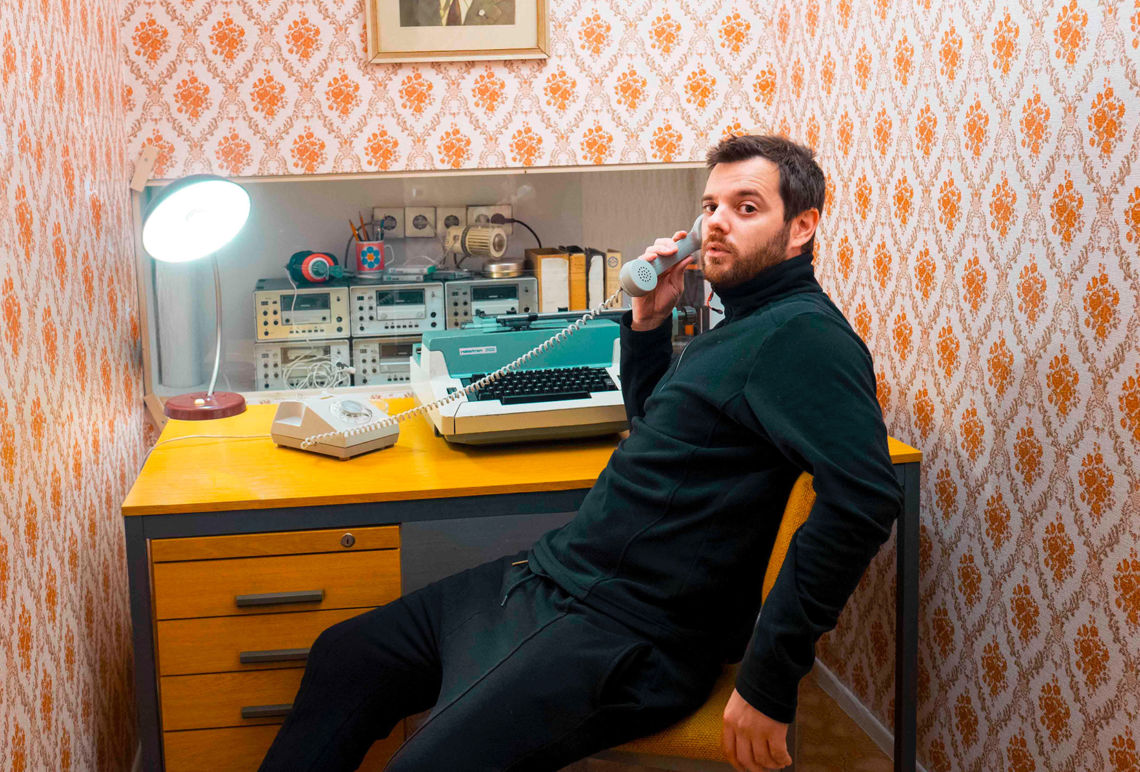
For his fourth album, Everything Is Borrowed (2008), Skinner seems distinctly more at ease. By now his hip-hop is in dialogue with pop and rock, so much so that in places he sounds like an heir to Beck. Unlike the melancholic spirit of the second album, this time there's an urban existentialism in the air, starting with the title track. There's fun to be had with the likes of "Heaven For The Weather" and the amusing, bouncy "The Way Of The Dodo", while the jazz-pop-rap of "I Love You More (Than You Like Me)" intrigues and the folk-rock tune of "On The Flip Of A Coin" surprises. There's even an eighties-style funk, "Never Give In", a childlike lullaby like "The Strongest Person I Know" and a touch of gospel on "The Escapist": it's an album that draws on the full range of Skinner's creative possibilities, trying out very different paths.
More and more clearly, he won't easily return to the sound of the debut, but he is now a humbler, more personal exponent of a moody, ironic alternative-hip-hop.
It receives lukewarm reviews from international critics, and seems to bring his career closer to an end, having lost a clear direction and ultimately any real creative drive. Skinner doesn't really hide it: his contract calls for five albums, so the next one will be the final chapter.
To whet fans' appetites, he releases the mixtape Cyberspace And Reds (2011), featuring Kano, Ghostpoet and many others alongside him. Curiously, it's his most underrated work, and it marks a new evolution towards vintage, often video-game-robotic sounds (there's even a track called "Robots Are Taking Over"!), which comes across as adrenaline-fuelled. "Came In Through The Door" (with the aforementioned Kano) recaptures the power of the debut's most aggressive tracks, as well as its closeness to grime on "Don't Hide Away" (featuring Wiley, Rinse and Ice Kid).
Skinner has broadened his influences in these productions towards jungle and rougher sounds, far removed from the icy 2-step beats of before, and it's an opportunity to reignite his inspiration. At under 40 minutes, given the modest size of Skinner's discography, it's recommended to anyone who has taken an interest in his artistic journey and isn't afraid to measure it against the official albums.
The following album, Computers And Blues (2011), delivers on the promise of video-game and retro-futuristic sounds, giving us Skinner's most imaginative productions since Original Pirate Material. Rather than trying out numerous paths, this time a new aesthetic is defined, an electronic, technological hip-hop that catapults "Planet Rock" thirty years into the future. From the chirping, digitized blues of "Outside Inside" it's clear that this time there's no mediation with past albums, and indeed on "Going Through Hell" the hybrid with rock comes via the rough guitar slashes of Robert Harvey of The Music, so that it's as if Rage Against The Machine had been born as a spin-off of White Stripes.
There's also a delightful pop sense of melody on "Roof Of Your Car" and "Soldiers", with 8-bit sounds for heavily treated vocals and vintage sci-fi special effects. In his exploration of the past, with its now-dusty drum kits and synths, Mike Skinner moves as a fresh kind of nostalgic, pushing uk-garage into a postmodern phase. What's more, his ability to write about everyday life and relationships in a simple, original way remains disarming, always staying a cut above banality while steering well clear of over-intellectualizing: on "Puzzled By People", for instance, he says "You can't google the solutions to people's feelings", on "Blip In A Screen" he tells fatherhood his own way, and on "OMG" he describes relationships on social media with disarming honesty.
The announced, long silence that followed can only leave a bitter taste. Granted, his discography isn't flawless, but it's undeniably alive and kept evolving right up to the last album, the one that closes out the five-record deal and settles the contract. Only in 2017 do two new tracks arrive under the name The Streets, "Burn Bridges" and "Sometimes I Hate My Friends More Than My Enemies". In 2018, "If You Ever Need To Talk I'm Here", "You Are Not The Voice In Your Head" and "Call Me In The Morning" are added, but then all of 2019 goes by with no new releases.
Only in July 2020 does a new mixtape arrive, None Of Us Are Getting Out Of This Life Alive. The lead single, "Call My Phone Thinking I'm Doing Nothing Better", brings in Tame Impala, considerably widening the pool of potential listeners and winking at the indie-rock crowd. The rest of the record features other artists on every track, from post-punks Idles to rapper Jimothy, by way of longtime collaborator Rob Harvey of The Music, making this sixth record the most collaborative and populated of his career. It's good to see an artist return to the scene who has too often been overlooked, having faded away before a new generation of uk-hip-hop could draw him into the genre's rebirth over the past decade. This mixtape, however, feels like little more than a sketch: without a genuinely new creative project, The Streets still remains an adventure belonging to the 2000s.
The album announced back in 2018 only arrives in 2023, titled The Darker The Shadow The Brighter The Light. Anchored to the fusion of electronics and rap from the opening "Too Much Yayo" onward, with an off-key chorus and synths that betray their age, The Streets nonetheless brings itself up to date with the machine-gun hi-hats typical of trap on "Money Isn't Everything" — otherwise a piece of funky house — and on "Bright Sunny Day". Things get worse when he strays further from his comfort zone, trying his hand again at intimism on "Walk Of Shame" over acoustic guitar, or when he slips into self-parody on the electronic reggae of "Something To Hide". Some tracks, further along in the sequencing, simply come across as muddled, as if Skinner wanted to transpose the experience of a dj set onto record, with somewhat clumsy results. Across the whole album, the lyrics disappoint too, but something in the closing "Good Old Daze" redeems, at least in part, a long-awaited but ultimately disappointing album.
For the sake of completeness, let's briefly mention Mike Skinner's other projects, starting with the minor releases under The Streets name. If the only EP, All Got Our Runnins (2003, released in the US only in 2009) seems mainly intended to cash in on the success of the debut, it does at least highlight the link with grime thanks to the collaboration with Dizzee Rascal and the Roll Deep crew. There's no reason to recommend, except to completists, the live document One Live In Nottingham, 31-10-02 (2019) and the two releases Remixes & B Sides and Remixes & B-Sides Too (2019). Rock fans, on the other hand, should track down the unlikely track with Muse, “Who Knows Who” (2009), a gem for the more curious listeners. The other project Skinner was involved in, admittedly far more marginal than The Streets, is The D.O.T., where he appears as producer, with the aforementioned Rob Harvey on vocals. The two albums And That (2012) and Diary (2013) are both forgettable. Skinner also composed the soundtrack for The Inbetweeners Movie (2011). The further projects Tonga Baloon Gang and The Darker The Shadow, The Brighter The Light (later used as the title for the sixth album) have produced little more than a handful of scattered tracks.
Add OndaRock to your favorite sources on Google Discover. Don't miss our reviews, milestones and latest news straight in your feed.
This article is an English translation of the original Italian text, published on OndaRock.it. It was translated with the help of artificial intelligence, under the editorial responsibility of OndaRock's editor-in-chief, Claudio Fabretti.
| Original Pirate Material (Locked On / 679, 2002) |  |
|
| All Got Our Runnins (ep, Vice, 2003) | ||
| A Grand Don't Come For Free (Locked On / 679, 2004) | |
|
| The Hardest Way To Make An Easy Living (Locked On / 679, 2006) | ||
| Everything Is Borrowed (679 / Vice, 2008) | ||
| Cyberspace And Reds (mixtape, self-released, 2011) | ||
| Computer And Blues (679 / Atlantic, 2011) | |
|
| One Live In Nottingham, 31-10-02 (BBC, 2019) | ||
| Remixes & B Sides (Warner, 2019) | ||
| Remixes & B-Sides Too (Warner, 2019) | ||
| None Of Us Are Getting Out Of This Life Alive (mixtape, Island, 2020) | ||
| The Darker The Shadow The Brighter The Light (Warner, 2023) |
 MilestoneRecommended by OR


