


There are more versatile instruments. More celebrated, more widespread, more iconic, more innovative ones. But none is as tied to one specific song as the Clavinet. There's no point beating around the bush: the Clavinet is “Superstition” - and “Superstition” is, to a large extent, the Clavinet. Ever since the 1972 release of Stevie Wonder's landmark track, the keyboard that can go toe-to-toe with a guitar has been inseparable from its warm, biting tones and irresistibly funky moves. Yet in its more than fifty years of history, the instrument patented by Ernst Zacharias — an employee of Germany's Hohner and also the inventor of Pianet and Cembalet — has been used by hundreds of artists across the most disparate genres, and even in the age of digital keyboards it retains a personality that's hard to replicate, one that kept it, until just a few years ago, not a collector's relic but an essentially irreplaceable musical asset.
 Zacharias's creation was born in the early Sixties, out of the intention to "electrify" the clavichord, a struck-string instrument widespread in Europe since the late Middle Ages. Used in a pop context by artists such as Beatles ("For No One") and Björk ("All Is Full Of Love", "My Juvenile"), the clavichord features a peculiar mechanism: when a key is pressed, the strings are simultaneously divided and set into vibration by small metal blades called "tangents", which remain in contact with the strings until the key is released. Since the length of the vibrating portion of the string is determined by the point where the tangent strikes it, the same string can be used, by varying the length of the vibrating section, to produce notes of different pitch: this feature made the clavichord a more compact and affordable alternative to costlier mechanical keyboards such as the harpsichord, spinet and piano.
The version built by Hohner does away with this peculiarity, dedicating one string to each key, and in fact it also does without tangents: instead, rubber hammers strike the strings and maintain contact with them in a way similar to the hammer-on technique familiar to guitarists and bassists. After experimenting with capacitive pickups in 1961 on the pioneering Claviphon, by the time the first Clavinet was marketed in 1964 Zacharias had already moved on to single-coil electromagnetic pickups — six pairs in all, one for every ten keys across the keyboard's sixty notes. As on many electric guitars, the musician can use a switch to choose whether to amplify the signal from just one coil or from both: the one positioned at the centre of the strings produces a rounder sound, while the one mounted near the bridge delivers a brighter, more aggressive tone.
Remaining virtually unchanged across the various models produced between 1964 and 1982, the Clavinet's mechanism features other original elements. While in the clavichord the string frame sits above the keys, with the tangents acting from below, in the Clavinet it sits below the keyboard and the hammers strike it from above. To "mute" the sound more quickly when the keys are released, each string is partially wrapped in textile thread: this makes replacing the strings – fortunately a rather rare task – a particularly laborious job. Another limitation of the instrument, due to the poor shielding of the pickups, is its tendency to generate hum and feedback: with the earliest models, the problem was so severe that it even pushed some musicians to rely on pre-recorded tracks live, to keep their Clavinet's sound from picking up, on top of the usual hum, unwanted radio interference as well!

From beginnings to consecration
Although its commercial debut came in 1964, the instrument only reached the US market in 1967. Among the earliest enthusiasts of the new sound were film-score composers and library music writers, as well as artists working in the easy listening vein. Unsurprisingly, this group also included the promotional record released by Hohner to showcase the keyboard's possibilities. These early uses, which in hindsight often had rather cheap ambitions, relied mostly on the novelty factor of the new timbre, presenting it in its most basic form while staying within well-established styles. Something bolder can be glimpsed in its first pop-rock applications: in the Lovin' Spoonful's "Six O' Clock", the Clavinet (mistakenly credited as an electric harpsichord) delivers the main riffs and operates in territory already fairly close to guitar, with a cutting edge; in "Up On Cripple Creek" the thoroughly funky groove is achieved by running the output through a wah-wah pedal. The same trick appears in the version of Piero Umiliani's famous "Mah-Na Mah-Na" recorded by Enoch Light and his band: the effected Clavinet, played by the great keyboard experimenter Dick Hyman, can be heard especially in the track's closing section.
Dieter Reith Quartett – Hohner Clavinet Klangbeispiele (1964?)
Jerry Goldsmith – In like Flint (1967)
Lovin’ Spoonful – Six O’ Clock (1967)
The Band – Up On Cripple Creek (live, 1969)
Enoch Light & The Light Brigade – Mah-Na Mah-Na (1970)
 Among the early adopters was also the artist who, more than any other, would come to be associated with the Clavinet's biting sound: Stevie Wonder. The first recording in which he used it was "Shoo-Be-Doo-Be-Doo-Da-Day", from 1968; within a few years, the bond between the soulman and the new keyboard would be so intense that it was immortalised in the lyrics of "Sweet Little Girl" ("Come on now honey-sugar, you know your baby loves you, more than I love my clavinet"). On closer inspection, the track doesn't actually feature the Clavinet at all, but Hohner was quick to exploit the reference anyway for its successful advertising campaign that year.
The most iconic piece in Stevie Wonder's Clavinet repertoire, "Superstition", is built on a layering of multiple Clavinet tracks, all played (in the studio) by Wonder himself. Here, more than in any previous track, the instrument's revolutionary nature comes through: it's a keyboard, yet it fills the timbral and functional role usually reserved for a guitar. Its bright, cutting sound allows it to step outside the classic vocabulary of organ and piano and instead embrace the playing techniques of riffing and vamping, which in those very years were fuelling funk's big bang.
The innovations Wonder brought to the fore don't end with his most iconic track. In "Higher Ground", the sound is transformed by the first auto-wah pedal in history, the Mu-tron III: the rise in volume associated with the attack of each note on the keyboard automatically triggers the characteristic wah-wah effect, consisting of a rapid oscillation of the frequency most boosted by the filter. The result is a continuous transformation of the timbre, turning from dark to dazzling, gaining a funk edge that would also prove essential to the legendary bass sound of Bootsy Collins.
From the early Eighties onward, moreover, the collaboration with technician Jim Williams (who would also work on the musician's Rhodes) made it possible to reduce high frequencies and hiss by replacing the built-in preamp, as well as to introduce other custom improvements such as a two-band equalizer to adjust the tone colour and better pickup shielding thanks to grounded metal plates. The result of this makeover left Wonder so satisfied that he kept using the instrument live even after replacing his trusty Rhodes with electronic keyboards. In the performance of "Superstition" shown in the video, the two-band equalizer can be spotted on the left side of the keyboard from the very first frames; just above it, a Boss AW-3 pedal stands in for the Mu-tron III as the auto-wah.
Stevie Wonder – Shoo-Be-Doo-Be-Doo-Da-Day (1968)
Stevie Wonder – Sweet Little Girl (1972)
Stevie Wonder – Superstition (1972)
Stevie Wonder – Higher Ground (1973)
Stevie Wonder – Superstition (live, 2008)
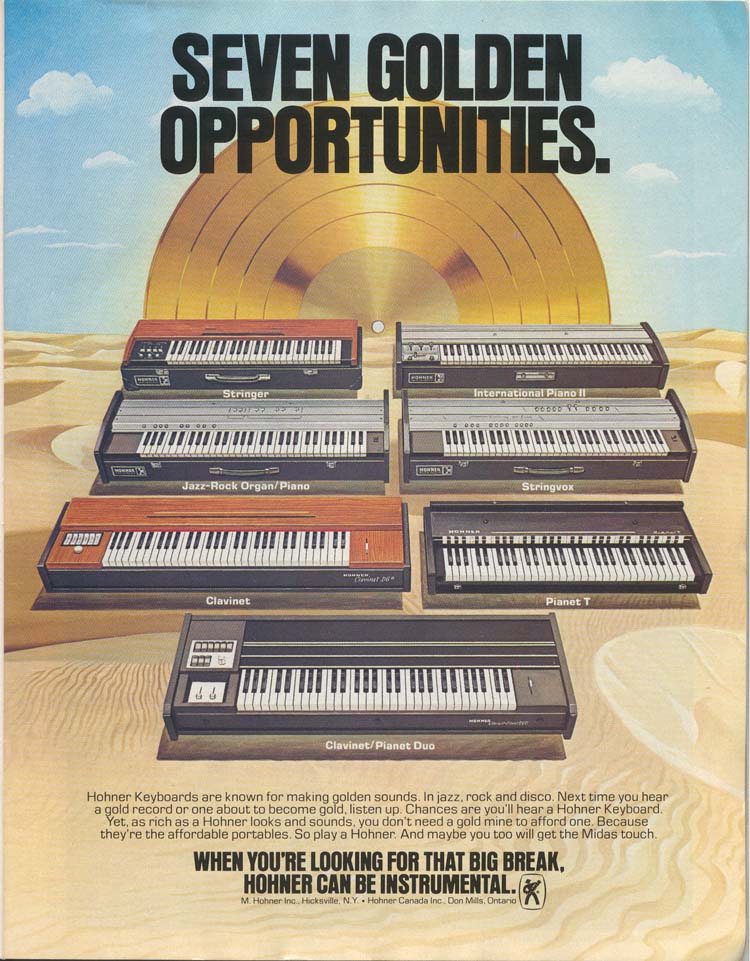
 In the early years of the Clavinet, Hohner released a succession of models, each with slight variations from the last. The first was the Clavinet I, launched in the United States (1967) at a price of $545 – two-thirds the cost of a Rhodes Suitcase, for comparison. The Clavinet II followed shortly after, and unlike its predecessor featured neither a built-in speaker nor amplifier (only a preamp). It was, however, the first model to include selectors for shaping the tone: those iconic white rocker switches that, growing in number over the years, would come to occupy the space to the left of the keyboard on later models as well.
In 1968, priced at $595, came the Clavinet C: this is the instrument heard on the original recording of "Superstition", recognizable in video and photographs by its white and red trim. With Hohner's authorization, the German company Echolette also produced a variant with a built-in ashtray and keys colored in reverse: the Beat Spinett, a collector's item today. That same color scheme also marked the Clavinet L, also from 1968: designed for home use, it had a built-in speaker and was distinguished by its trapezoidal shape.
By far the most successful model, the Clavinet D6 made its debut in 1971. Its launch price is unknown, but period materials show its list value in 1973 was $849.50 – just under that of a contemporary Rhodes Stage Mark I. Here the rocker selectors grew to six: two controlled the pickups and their polarity (if the two pickups are in phase the sound is full, if out of phase it's thinner), while the other four acted on low-pass and high-pass filters for further shaping the tone ("medium" and "soft" were the low-pass settings; "brilliant" and "treble" the high-pass ones). Each option could be activated independently of the others. On the right side of the keyboard, a "mute" slider also appeared, which shortened the sustain and gave the sound a more "clipped" character, compared by some enthusiasts to the effect of palm muting on guitar.
The D6's orange-hued look makes it instantly recognizable, and video evidence makes clear that, throughout the Seventies, it was the most widely used model. Stevie Wonder adopted it too, and it's precisely his D6 that was the subject of the custom modifications discussed in the previous paragraph. Still prized today for its playability, it circulates on the second-hand market at prices ranging between €2,500 and €8,000, depending on condition.

The Voice of Funk
 In genres where instrumental passages play a central role, the Clavinet caught on very quickly. Within a few years, it became one of the symbols of fusion: as early as 1967 Don Ellis used it in his big band, one of the first to play electric jazz in odd time signatures (in the brief clip shown, the keyboardist weaving through the aksak rhythms is Pete Robinson, never shown on camera). Predictably, Germany was a hotbed for the instrument's rise, with jazz-rock pioneers Passport making it shine within their rich blend of keyboards and guitars. From the first half of the Seventies, it became a key ingredient in the funky sound of Herbie Hancock, where it held a prominent place alongside the Rhodes and the ARP Odyssey and ARP Pro Soloist synthesizers.
Hermeto Pascoal, an eccentric and dazzlingly versatile figure in Brazilian jazz, used the Clavinet at least as far back as 1977's "Slaves Mass". Later, he turned to the bizarre Clavinet-Pianet Duo, a hybrid of the Pianet T and the Clavinet E7 (the last in the Clavinet series, launched in 1979) produced by Hohner between 1978 and 1982. The instrument was heavy and complex, fitted as it was with both the Clavinet's and the Pianet's mechanics. It was, however, extremely versatile: a foot-operated selector allowed the player to set the mix between Pianet and Clavinet in the sound, and dedicated controls made it possible to assign the two components to different parts of the keyboard and to the two separate stereo channels.
George Duke, a legendary keyboardist also known to rock fans for his collaborations with Frank Zappa, had a whammy bar similar to those found on some famous electric guitars fitted to his heavily modded transparent D6. Designed by technician Buddy Castle, the system allowed the string bridge to be tilted, producing a very pronounced vibrato that Duke would put to use on his disco romp "Reach Out".
Don Ellis – K.C. Blues (live, 1968)
Passport – Uranus (live, 1971)
Herbie Hancock – Chameleon (live, 1965)
Hermeto Pascoal @ Montreaux Jazz Festival (live, 1979)
George Duke – Reach Out (live, 1983)
 Much of the vocabulary that fusion drew on for the Clavinet comes from the strand that invested most heavily in the instrument's potential: that funk/funky/disco continuum which, throughout the Seventies, wove such a dense dialogue with jazz that the boundaries between categories were often blurred. The exhilarating episodes in which the Clavinet steals the show are practically countless: for this reason, it's worth devoting a dedicated themed playlist to them, and limiting ourselves here to a general overview.
Among the earliest hits of Clavi-funk is "Outa-Space", a Billy Preston single taken from his first post-Apple album, released on Herb Alpert's label with arrangements by Quincy Jones. The track, born out of a jam and built around wah-wah to achieve a particularly plastic sound, reached number two on the US charts and gave a considerable boost to pop uses of the Clavinet. Another indispensable name is Bernie Worrell, keyboardist for Parliament and Funkadelic (as well as for the Talking Heads in "The Name Of This Band Is Talking Heads"-"Speaking In Tongues"-"Stop Making Sense", and for Bill Laswell's Praxis). One of his Clavinet D6s, its keyboard decorated with cutouts from Popeye comics, went to auction in 2017 for $20,000.
In Earth Wind And Fire, Larry Dunn is responsible for some of the grooviest Clavinet passages ever to hit the sales charts. "Build Your Nest" is certainly not their best-known track, but it's one of those in which the Clavinet's skeletal yet rock-solid sound is most prominent: here too, much of its personality comes from the wah-wah, which fades in and out over the repeated chords, making them piercing and richly textured.
Jumping ahead to the end of the decade, we come across the early work of the champion of synth-funk, Prince, who initially borrows and simplifies Clavinet patterns that had become standard in the first half of the Seventies, soon reworking them into the rich arsenal of synthesizers that would define his career. Many years later, when Jamiroquai revived the funky sound of the golden years and updated it to the gospel of acid jazz, keyboardist Toby Smith bet everything on the Clavinet-Pianet Duo, often paired with the Fender Rhodes. His are among the sharpest licks ever played on the instrument, ranging widely in tone from a clean sound to the classic wah-wah, all the way to more venomous, biting tones obtained by exploiting the distortion produced by the amplifier's overdrive.
Billy Preston – Outa-Space (1971)
Funkadelic – A Joyful Process (1972)
Earth, Wind & Fire – Build Your Nest (1973)
Prince – Why You Wanna Treat Me So Bad? (1979)
Jamiroquai – The Kids (live, 1993)
Rock's redemption
 Its use in rock is extensive, and especially in the prog field it takes on a guise quite different from the prevailing one. The aggressive character of the Clavi-sound is of course appreciated, but rather than its funky potential, what's valued here is its evocative power. The Clavinet is seen above all as a harpsichord on steroids, a means of adding further emphasis and grandeur to the elaborate scores devised by these bands. Showing the way, predictably, is Keith Emerson, who on the first Emerson, Lake & Palmer album uses precisely a blistering classical-contemporary Clavinet sequence to introduce the first extended Moog solo in the history of prog, and indeed of rock as a whole (again with the Clavinet laying down the carpet beneath it).
The Clavinet plays a counterpoint role in the televised medley "Sguardo verso il cielo/Una dolcezza nuova" by Le Orme, in which most of the riffing and soloing is handled first by the Hammond and then by the piano. Comparing this with the originals recorded on the studio albums, it's interesting to note how many of the Clavinet parts have been transferred to other instruments (orchestra, organ, Minimoog), with the Clavinet left to handle only the sharpest breaks, where the other timbres wouldn't have been as incisive. The same comparison also reveals how, in the original tracks, the Clavinet covers the functional range of many other instruments: undeniable proof of its versatility.
The most peculiar use of the Clavinet in this field, however, is that of Gentle Giant, who place it at the centre of their sound with a threefold function: an aggressive element, a pre-industrial callback (through its loose analogy with the harpsichord), and the linchpin of abstrusely jagged constructions. The result is a unique fusion, one that makes ancient and thoroughly modern elements sound together, weaving some of the most convoluted and immediate interlockings of melody, chords and time signatures in the whole of progressive rock.
More conventional is its use by Pink Floyd, who employ it both in "Have A Cigar" and in the eighth section of "Shine On You Crazy Diamond" — decidedly buried in the mix in the first case (it appears just before the vocal enters), and certainly more prominent, though also stereotypically funky, in the second. Atypical for the music of Van Der Graaf Generator, the Clavinet makes its appearance on their most abrasive album, "Godbluff", where it fuels the second half of "The Sleepwalkers" with big chords. Played by Peter Hammill, it kicks off on a very rock-solid 4/4 and holds its own throughout one of the most elusive odd-metered episodes in their songbook, confirming itself as the perfect instrument for translating the roughness of sandpaper into prog-rock terms.
ELP – Tank (1970)
Le Orme – Sguardo verso il Cielo/ Una dolcezza nuova (live, 1972?)
Pink Floyd – Shine On You Crazy Diamond, pt. 8 (1974)
Gentle Giant – Cogs In Cogs/Proclamation (live, 1974)
Van Der Graaf Generator – The Sleepwalkers (live, 1975)
Setting aside idiosyncratic styles like that of Gentle Giant, the uses of the Clavinet encountered so far can be grouped into three schools: the funk school, guitar-derived, which favors rhythmic chord repetition (vamping) with varied accents and interplay of anticipations and delays; the neoclassical/neo-baroque school, which updates and adds further grandiosity to the late-Sixties use of the harpsichord; and a more square-edged, aggressive style, halfway between a guitar riff and big organ or piano chords, as seen for example in the Van Der Graaf Generator piece. One could label this last case "rock", but on closer inspection all three styles turn up within rock, without any clear predominance of the one just described.
Grand Funk Railroad's "Stop Lookin' Back" could be cited as a prototypical example of hyper-rock use of the Clavinet: its job is essentially to hold down a hard ostinato, with a crisp sound that makes every note stand out without sacrificing the timbre's bite. A track in which all three "dialects" coexist, on the other hand, is the exceptional "Jeremiah" by christian-rocker Michael Omartian, which alternates pompous harpsichord-like passages, a funk groove, and, shortly after the halfway point of the song, a vigorous if oblique rock break.
Undoubtedly most famous is the distorted Clavinet of Led Zeppelin's Led Zeppelin "Trampled Under Foot", which combines an obvious funk debt with a keyboard technique essentially borrowed from the language of the blues organ (the stylistic closeness is especially clear in the solo). Similarly robust is the sound put to use by the Allman Brothers for "Can't Lose What You Never Had", where the Clavinet doubles the piano to make the keyboard part hoarser and more punchy. Wispier and funkier is Joe Sample's performance on Steely Dan's Steely Dan "Black Cow", where a phaser is paired with the instrument and the reverb spills over onto the opposite stereo channel.
Grand Funk Railroad – Stop Lookin' Back (1973)
Michael Omartian – Jeremiah (1974)
Led Zeppelin – Trampled Under Foot (live, 1975)
Allman Brothers – Can't Lose What You Never Had (1975)
Steely Dan – Black Cow (1977)
From the Caribbean to the Future
 From the second half of the 1970s onward, another language developed for the Clavinet exerted a strong influence on Anglo-American music, and in turn on other national scenes as well. This was the reggae approach, and in particular the (self-declaredly) "non-purist" version worked out by keyboardist John "Rabbit" Bundrick to make Bob Marley's style more palatable to American audiences. By the dawn of Marley's "American landing" with "Catch A Fire", the Clavinet was already an instrument in use within reggae since the late Sixties, but with very sparse parts, usually buried in the mix: Bundrick's insight was to borrow techniques already established in funk and rock, to which potential listeners' ears were already attuned, and adapt them to the new context. The result comes in two guises: on one hand, dry, clattering parts acting as a counterpoint (or a support) to the ever-present off-beat guitar; on the other, a sound completely liquefied by the wah-wah, which conceals the punch of the attack noise and the instrument's characteristic bite, leaving only the release. The Clavinet's centrality is such that in "Stir It Up" the second half of the track is given over to a remarkable and quite extended overdub solo, which shows the full expressive freedom allowed by the new style.
Another exemplary track is Peter Tosh's “I’m The Toughest”, which features numerous distinct Clavinet tracks, largely used percussively and boasting a dry, meaty tone. It's no coincidence that one of the most iconic reggae-influenced songs in Italy in the late Seventies, “E la luna bussò”, prominently features a Clavinet from the second verse onward. Even the prince of the Clavinet himself, Stevie Wonder, would pay tribute to Bob Marley and the new style with “Master Blaster (Jammin’)”, in 1980.
In the pop field, other styles also took shape over the course of the Seventies. The Electric Light Orchestra, which had started out with a progressive pop sound with decidedly classical and Beatles-esque leanings, increasingly incorporated disco elements into its sound; on tracks like “Evil Woman”, “Showdown” and above all “Last Train To London”, the band honed a hyper-melodic approach to the Clavinet, with sharply defined, mechanical lines that already seem to be in dialogue with the electronic architectures Giorgio Moroder was developing during the same years. (Note: in the official video for “Evil Woman”, the Clavinet part is misleadingly matched to shots of a Polymoog).
More subtle and harder to trace is the use made of it by ABBA, who seem to have inserted it into various songs as an ingredient of their wall of sound, to add brilliance to the mix: direct evidence of its use in the studio is scarce, though there are passages where its presence can be inferred. Live footage from 1979-1980, however, is unequivocal: in live performances, the Clavinet even plays lead lines, and it's clearly visible in the recordings.
Bob Marley – Stir It Up (1973)
Peter Tosh – I’m The Toughest (1977)
Loredana Bertè – E la luna bussò (1979)
Electric Light Orchestra – Last Train To London (1979)
ABBA – Gimme! Gimme! Gimme! (A Man After Midnight) (live, 1979)
Once production ended in 1982, the Clavinet didn't disappear from circulation. The complexity of its timbre, sharp because it's rich in non-harmonic overtones, makes its sound difficult to emulate compared to electric organs and e-pianos: in the following decades, then, the instrument retained a fairly stable niche of use right up until the start of its inevitable revival in the mid-Nineties. There's no point attempting a full survey of everyone who's revived it: a few outstanding examples will suffice to show the variety of contexts in which artists clearly still love the Clavinet, even if it's no longer strictly irreplaceable (besides the physical modeling offered by the ubiquitous Nord keyboards, there are also solid electromechanical imitations on the market).
Even setting aside the various imitative sounds out there – the one in Gorillaz's “Dirty Harry”, for instance, is according to the credits actually a synthesizer – many uses of the instrument come with an undeniable retro spirit attached. Whether it's the groove of Calibro 35's poliziottesco soundtracks, Mark Ronson's neo-funk, or the tightrope-walking fusion of Snarky Puppy, it's clear that the Clavinet's buzzing notes are mainly there to resurrect a specific style – with class, of course.
There are, however, more surprising rediscoveries: Roy Powell's Clavinet is a central element in the Crimson-style jazz-rock of Mumpbeak, where it holds its own against Pat Mastelotto, Bill Laswell, Tony Levin and Shanir Ezra Blumenkranz with a barrage of inventions that often transform its timbre almost beyond recognition. Even more extreme is the virtuosic language of Australian musician Lachy Doley, who by combining every technical trick ever historically devised for the instrument (whammy bar, wah-wah, amp distortion) makes the Clavinet's sound virtually indistinguishable from that of an electric guitar. In the video below, his reinterpretation of a Seventies Clavinet classic, Bill Withers' “Use Me”.
One final gem for those curious about performance technique: a video in which current Jamiroquai keyboardist Matt Johnson demonstrates the main Clavi-funk techniques on a modern electromechanical heir to the instrument, the Vibanet, launched in 2013 by Vintage Vibes.
Mark Ronson ft. Lily Allen – Oh My God (2007)
Calibro 35 – Arrivederci e grazie (live, 2011)
Mumpbeak – Biscuit (2013)
Lachy Doley Group – Use Me (live, 2016)
Snarky Puppy – Grown Folks (live, 2018)
Add OndaRock to your favorite sources on Google Discover. Don't miss our reviews, milestones and latest news straight in your feed.
This article is an English translation of the original Italian text by Marco Sgrignoli, published on OndaRock.it. It was translated with the help of artificial intelligence, under the editorial responsibility of OndaRock's editor-in-chief, Claudio Fabretti.


