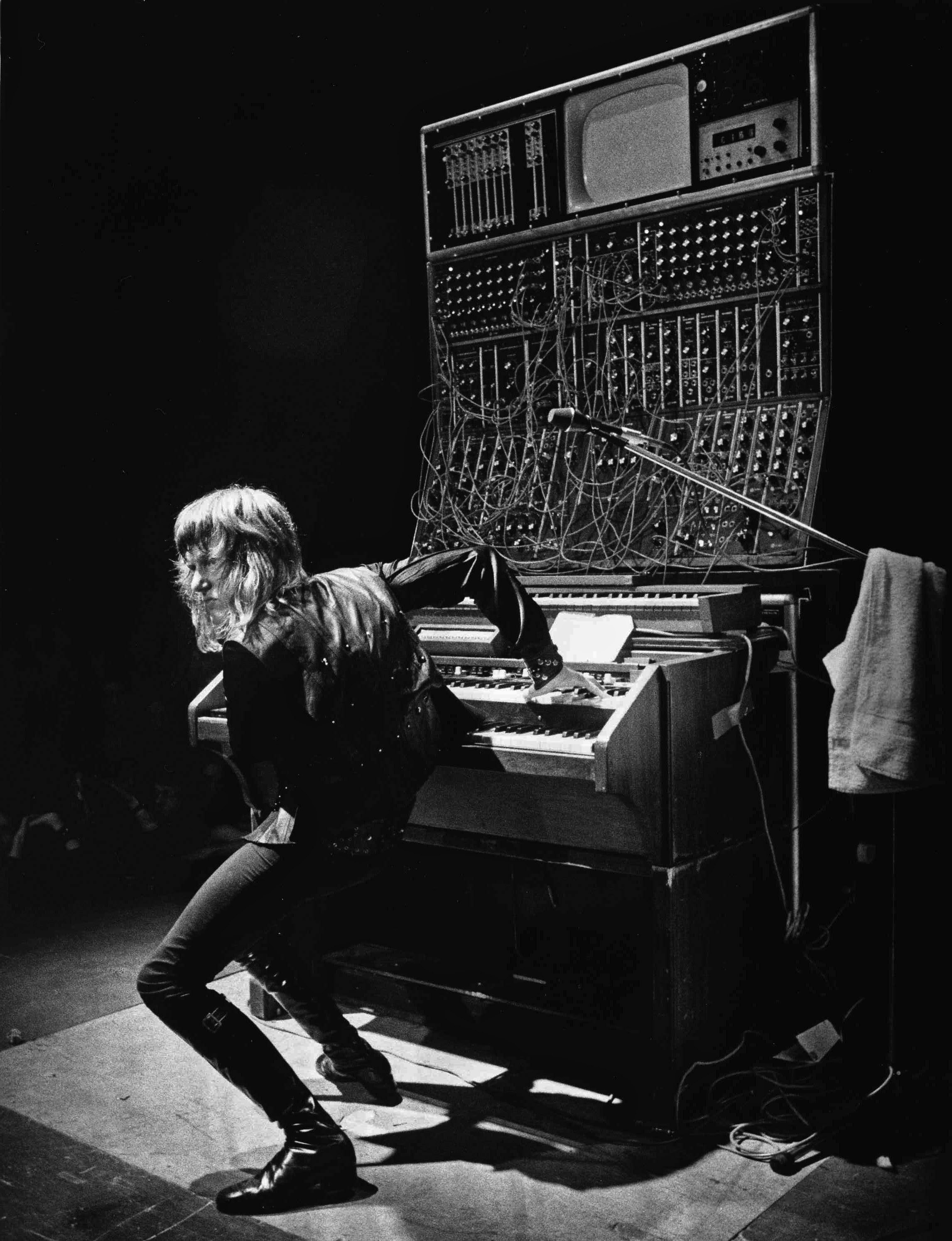
In a 2016 that seems bent on undermining the very foundations of rock music, we now also lose Keith Emerson. Apparently by suicide, though the causes remain unknown, and in any case that's not something worth dwelling on.
Remembering such a complex figure isn't easy, because like all the greatest personalities in rock, Emerson moved across multiple dimensions. Crossing sociology with musical analysis on the emotional wave of his death could lead to overblown pronouncements. Which we'll make anyway, for two reasons: first, Emerson was a master of grandeur, so tossing around a few big words to remember him fits well with his legacy; second, if there's anyone who deserves a bit of enthusiasm after decades of shaky accusations, it's him.
 Keith Noel Emerson was, without mincing words, the most important keyboardist in the history of rock. Establishing who was the greatest doesn't interest us, since that's a game too tied to personal taste: some will prefer the languid tones of Richard Wright, others the elegance of Rick Wakeman, others still the hard, Bach-like rock of Jon Lord, and so on.
But who else could boast Emerson's stylistic completeness? Who else was equally at ease with atmospheres that could be comic one moment and dramatic the next? Who else could conjure grotesque saloon scenes and then, a second later, shift aboard a spaceship? Who else could move from William Blake's “Jerusalem” to Dario Argento's “Inferno”? Who else handled ragtime, jazz, folk ballads, exotic temptations and every shade of classical music - from centuries past to 20th-century avant-gardes devoted to the treatment of noise - with such mastery?
Several prototype Moog synthesizers were sent to Emerson so he could test them on record before they hit the market. And he was chosen not just for his fame - there was no shortage of bands with famous keyboardists at the time - but because with him you could be certain the instrument would be pushed to its fullest, showing off its tonal range and technical possibilities from every angle.
The result was music so far outside the norm that even today's most seasoned listener might find it dated. But that's simply the difficulty of placing it within a familiar cultural space. Aside from the new progressive rock scene, which is essentially a niche, Emerson's legacy has actually been picked up in a rather lopsided way, and certainly not by indie rock bands, who lack the technical means needed to follow in his footsteps.
In Japan, for instance, his shadow has moved underground, but with considerable weight: just think of video game soundtracks. Doesn't it feel like you're hearing a distillation of the earliest “Final Fantasy” installments when, in the track titled “Trilogy,” the synths and rhythm section kick in? If you're not convinced, listen closely, because Nobuo Uematsu himself has stated that he drew heavily from Emerson, and he's rather proud of it too.
 Without even leaving the Land of the Rising Sun, one can find a superb orchestral reinterpretation of “Tarkus” by Takashi Yoshimatsu, an undertaking that gives every fragment of the original version new space and a new set of timbres, revealing how those “empty runs” and “cold displays of virtuosity” - labeled as such only because they were performed by a rock band - were in fact precise compositional lines, perfectly interlocked with one another, harmonically satisfying and, in orchestral guise, capable of revealing all their warmth.
And of laying bare the impressive richness of Emerson's palette: hence the rhythmic explosions of Stravinsky, the menacing ostinatos straight out of “Danse macabre,” the Hollywood inflections of Henry Mancini, the classical yet jazzy dynamism of Gershwin, but also landscapes surprisingly in line with the melodies of the Far East, close enough to draw a direct line to the work of Joe Hisaishi. One might suspect these are touches added by the arranger, but then you go back and listen to the original, and there they are, once you strip away the electric shell of the organ and the distorted bass.
Of course, saturating the timbre of the instruments to such an implausible degree wasn't the best move for anyone aiming to bring out dynamics worthy of classical music, but the point is that Emerson only cared about that up to a point. Clean tone was what the academies would have demanded for that kind of music, whereas his mission was precisely to mock those professors who claimed the right to tell everyone else how Bach and Tchaikovsky should be played - even at the cost of turning the balance hidden beneath a flower into raw sonic violence.
All this concerns not just his music, but also his persona - or rather, the part of his persona he allowed to show in public. An anarchic artist, jovial with his collaborators, yet unwaveringly principled, who never betrayed himself over the course of half a century: the tamer of keyboards, the gladiator who every night challenged electronic beasts in the arena, while the crowd roared and demanded blood.
There are so many anecdotes about his live shows that the line between fact and legend has been completely lost, and while we do have footage of the Hammond organ played in mid-air and stabbed with a knife, there's no documented trace of the cheerful pee on the British flag - an incident that in all likelihood never happened, but that one would like to believe simply because he'd have been capable of it.
His relationship with keyboards was a symbiotic one, and it earned him countless comparisons throughout his career with Jimi Hendrix, with whom he actually had little in common beyond a mutual respect that at one point brought them close to collaborating. Still, it's fair to have serious doubts about how well that project would have worked, because it's genuinely hard to picture Emerson in the background, patiently waiting for some long blues digression to run its course.
Because he was the one who'd hoist a two-hundred-pound Hammond up and spin it on its edge before smashing it to the ground, the one who took the stage flanked by walls of electronic machinery pierced by a thousand cables, which he'd rearrange to get combinations that made sense only in his own head. And with every wire moved, the sound grew meaner, sharper, more inhuman.
 Emerson's iconic power is immense, arguably so immense that it ended up turning him into a target for a certain kind of listener. But their disparaging attention only confirms his stature: like it or not, Emerson is a figure you have to reckon with, because he wasn't just "a" keyboardist, he was "the" keyboardist.
A telling example is the photo on the left, taken by Barrie Wentzell (here for a larger version): the artist in a spider-like stance, dark and menacing, poised to strike, with the keyboard behind him and a monster of electric tentacles. Aided by a gorgeous black-and-white treatment, the image can today look like a futuristic take on "The Phantom of the Opera", the mad scientist of some 1930s Universal horror film, or the cyberpunk nightmare of some manga. One man, one pose and one machine, conjuring up a thousand possible worlds.
Add OndaRock to your favorite sources on Google Discover. Don't miss our reviews, milestones and latest news straight in your feed.
This article is an English translation of the original Italian text by Federico Romagnoli, published on OndaRock.it. It was translated with the help of artificial intelligence, under the editorial responsibility of OndaRock's editor-in-chief, Claudio Fabretti.