


The Isle of Wight and the rave party don't seem to have much in common. Sure, both are symbols of youthful freedom and the desire to build, through music, a different way of being together. But they're separated by roughly thirty years of profound transformation in British society. Many of the hippies and curious onlookers who breached the fence at the last edition of the "European Woodstock" on 26 August 1970 (clandestinely immortalised by the graffiti "Entrance is everywhere", later removed) might have looked with some concern, decades later, at the crowds of night owls gathering in fields and abandoned industrial sites to dance until dawn, hypnotised by hardcore techno. Different eras, different musical horizons, even different drugs.
And yet an unbroken thread links these two generational totems, running through the musical and countercultural history of the United Kingdom. It's a continuity born in that underground where the boundaries between progressive rock and late psychedelia blur, one that explores the possibilities of early electronics, renews itself with the advent of punk, and brings it face to face with the nascent new age. And then discovers trance music before it even has a name, eventually connecting to the synthetic beats of the very dance music it once imagined itself a radical alternative to.
Setting aside the earliest experiments (Beckenham and Cambridge, 1969; Phun City, July 1970), the story of the free festival has a clearly identifiable symbolic starting point: 27 August 1970, at the third Isle of Wight festival. In the tent city outside the fenced-off area reserved for paying punters, who had come to see the biggest names of the era (from Supertramp to Chicago, from the Doors and Donovan to Miles Davis, Pentangle and Joni Mitchell), three bands set up a makeshift stage and played for free for anyone who chose to watch the concerts from a distance. These were hot names on the underground scene of the time: Hawkwind, Pink Fairies, T2. Their performances lasted a fraction of the official five-day event, and the wattage at their disposal was nowhere near what powered the music of Jimi Hendrix, Emerson Lake & Palmer and the Who. But the racket they made (still considerable, given who was involved) was less disruptive than the idea it conveyed: that the marriage between the market and pop music could be broken, even if only for the length of a festival.
Developments were quick to follow, and this time in grand style. The Glastonbury festival debuted on 19 September 1970, with a £1 ticket that would be scrapped entirely the following year. The event is held on a site — the Somerset plain — steeped in ancient and modern mythology alike, and its organisers drew inspiration from the 1969 cult book "The View Over Atlantis" to link the gathering to megalithic rituals, Arthurian legends and mystical geometries formed by intersecting ley lines. The stage on which the artists perform is a pyramid with clear esoteric references, one that over the years would be trodden upon and gradually enlarged to host first the Kinks, Marc Bolan and Quintessence, then Hawkwind, Traffic, Gong, David Bowie, Peter Gabriel... right up to today's headliners like Coldplay, Taylor Swift and Kendrick Lamar (with ticket prices now entirely comparable to those of Europe's other major festivals).
 Throughout the 1970s, the free festival circuit looked beyond the ever-growing hypertrophy of Glastonbury, spawning a host of smaller gatherings and events of national resonance, such as the Windsor Free Festival (held between 1972 and 1974 on land unlawfully occupied on the royal estate west of London) and, from 1972 to 1984, the Stonehenge Free Festival.
The bands who played these events were numerous and varied, but a handful of recurring names stand out and end up defining what people expect from "free festival music": besides the "founders" Hawkwind and Pink Fairies (to whom one should add at the very least Arthur Brown and the Edgar Broughton Band), the most significant regulars certainly include Gong, East Of Eden, Quintessence and the Third Ear Band. Bands with one foot in what we now call progressive rock (though the term was far less defined at the time) and the other in the long tail of psychedelia, in electronic space rock or in the noisiest strands of the underground; sometimes also steeped in a mysticism that paired ethnic fascinations with a steady lysergic diet.
Music, however, was not the only spirit animating these gatherings, nor perhaps was it even the main one. What drove the emerging festival crowd to criss-cross Britain in search of ever more rural destinations was above all the communal atmosphere that defined these events, which on occasion stretched on for weeks and gave rise to small tent-and-caravan towns where one could easily find food, spiritual guidance, crafts made on the spot, drugs, or a hand with practical chores.
As the festivals grew longer and more numerous, the concern of the authorities mounted too, and in 1974 British police stormed the roughly ten thousand people present on the sixth day of the Windsor gathering, arresting those who refused to disperse. The heated public debate that followed pushed Harold Wilson's Labour government, the following year, to designate a location where such events could take place with official approval: thus in 1975 the People's Free Festival was held at Watchfield, merging from 1976 onward with the Stonehenge festival (this time without government authorisation).
As the 1970s wore on, some changes came to free festival music and its audience: just as the sound and the subculture were forging their own identity, economic uncertainty and the punk wave shook the scene to its core. The hippies and freaks of the earlier years were joined by squatters, young and not so young, driven by a spirit that was often more confrontational and combative. Integrating the two crowds wasn't always easy, but the cross-pollination produced some fascinating musical results, such as the ever-present Here & Now (somewhere between Canterbury and This Heat) or the ramshackle Astronauts (a prog-wave hybrid with something of the Fall, something of Devo, and just the right amount of the Stranglers and Gong).
By the early 1980s, the free festival scene could no longer be dismissed as a passing fad: it had become a genuinely cross-generational culture, organising itself into sprawling structures and giving rise to convoys of vehicles moving from one event to the next throughout the summer season. Over time it also absorbed people pushed toward a nomadic life by the rising unemployment of the Thatcher era, and these bands of travellers took the shape of permanent communities: thus the New Age traveller movement was born, with music festivals now serving merely as a point of convergence. Recounting the phenomenon through first-hand testimony, the BBC's Timeshift documentary series, aired in 2004, identifies a spirit of mutual trust and support as the glue holding together these partially self-sufficient micro-societies (disparagingly nicknamed "crusties" by the tabloids).
By the middle of the decade, the scale the movement had reached once again drew the attention of the government, which unleashed its armed wing in what became known as the "Battle of the Beanfield": on 1 June 1985, the roughly six hundred travellers of the Peace Convoy ran into a roadblock manned by thirteen hundred police officers, set up to prevent them from settling in for the Stonehenge festival. The clashes that followed, marked by heavy-handed violence from the police, left many injured and resulted in the largest mass arrest since the Second World War: 537 people were detained. The following year, the Conservative-majority parliament passed the Public Order Act, expanding police powers to break up unauthorised "public processions" and remove potential "trespassers" from public and private land. It was a measure deliberately hostile to free festivals and New Age travellers, marking a point of no return for the movement's staying power.
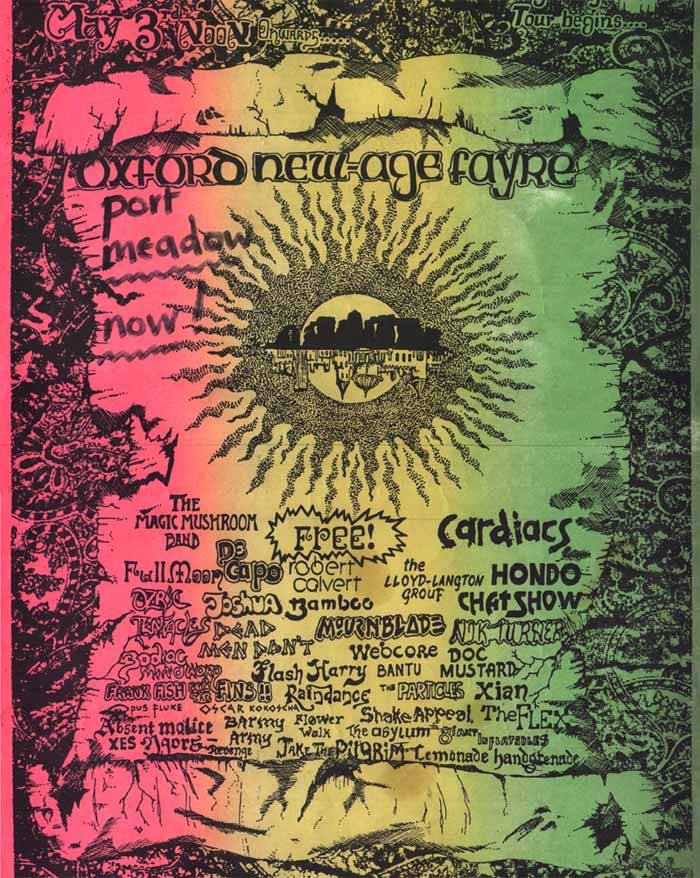 Although the fabric connecting festivals and travellers gradually frayed through the 1980s, the period marked a great musical flowering for the subculture. Punk-inflected bands rose to prominence, thanks above all to the role of the anarcho-punk outfit Crass and, later on, the Celtic-tinged punk-rock of the Levellers (named after the proto-socialist 17th-century movement). The psychedelic streak, meanwhile, remained clearly visible in Cardiacs and related bands (Ad Nauseam, Poisoned Electrick Head), as well as in acts like Solstice, whom the music press and record labels tried to file under neo-progressive due to their affinity with Renaissance and Curved Air, but whom witnesses of the time instead describe as "stoners" and "the last of the great hippie bands".
Above all, though, from the melting pot of very late psychedelia, new age electronics, space-rock echoes inherited from Hawkwind, do-it-yourself spirit and prog leanings, an emblematic style emerged, with the jam band Ozric Tentacles as its definitive template. At the heart of this new aesthetic are long, trippy instrumental excursions combining distortion and sequencers, piling on rhythmic layering, odd time signatures and exotic flourishes. An electronic trance-rock that would spawn a whole host of followers: Omnia Opera, Mandragora, Magic Mushroom Band, Webcore, Nukli, Ullulators, Oroonies, Nodens Ictus... And, surprisingly, it would even break into the mainstream in the early Nineties, taking the album "Jurassic Shift" (1993) into the charts for four weeks.
It's easy to imagine that these hypnotic sounds and their communal setting, together with the emerging hardcore techno scene, provided inspiration for the new generation of musicians and enthusiasts responsible for the rave culture boom of the very early 1990s. Once again, the continuum that had sprouted in the late 1960s found fresh life through an unexpected infusion of new audiences, ideas and technologies. If the ravers brought with them new sounds, drugs and inventive workarounds (camping too long outside your own land is banned? then events will simply last one night!), the seasoned travellers had hospitality and a decade's worth of expertise to offer in return. The fluid collective Spiral Tribe, with its many offshoots, is the soundsystem that did more than any other to popularise the freetekno cultural syncretism, and it's also the one that paid the highest price when a fresh security crackdown arrived to choke off the movement's spread.
The Castlemorton festival, at the end of May 1992, is the largest free musical gathering since the days of the Stonehenge gatherings, and it ends with the arrest of thirteen members of Spiral Tribe. The media fallout from the event will allow the Major government to introduce the Criminal Justice And Public Order Act in 1994, containing the infamous ban on gatherings of twenty or more people at which music is played that includes "sounds wholly or predominantly characterised by the emission of a succession of repetitive beats". That same year, in direct response, Autechre will release the EP "Anti", an unpredictable stream of IDM disrhythms specifically designed to dodge the ban. But that's another story, to be told another time.
Add OndaRock to your favorite sources on Google Discover. Don't miss our reviews, milestones and latest news straight in your feed.
05/01/2026
This article is an English translation of the original Italian text by Marco Sgrignoli, published on OndaRock.it. It was translated with the help of artificial intelligence, under the editorial responsibility of OndaRock's editor-in-chief, Claudio Fabretti.
Compilation:
AA.VV. - A Psychedelic Psauna (In Four Parts) (Delerium Records, 1991)
AA.VV. Dave Brock Presents... This Was Your Future 1978-1998 (Cherry Red, 2022)
Bibliografia:
Rob Young - Electric Eden: Unearthing Britain's Visionary Music (Faber & Faber, 2011)
Ian Abrahams, Bridget Wishart - Festivalized: Music, Politics And Alternative Culture (Gonzo Multimedia, 2015)
Chris Anderton - Music Festivals In The UK: Beyond The Carnivalesque (Routledge, 2018)
Videografia:
Time Shift - New Age Travellers (BBC4, 2004)
Sitografia:
UK Rock Festivals


