


The two-decades-plus history of the mysterious atmospheric black-metal project led by Swiss musician Tobias Möckl, set in an Arctic realm of his own invention
In the canton of Bern, in the small town of Burgdorf, everything seems to be ruled by a "postcard landscape." Just under 17,000 souls live in the Emmental district, amid green pastures and stunning Swiss mountains. If we had to pick a backdrop against which to set a tormented soul, Burgdorf would be among the last places on the planet to come to mind. Yet it was in this cheerful little town that Tobias Möckl founded his atmospheric, abstract and cosmic black-metal project titled Paysage d'Hiver. The contrast between the grim alternation of desolation and anguish that runs through his compositions tells a reality that is anything but idyllic, reaffirming that every human mind is an inner cosmos that coexists — at times in conflict — with the spaces the body inhabits.
The project is a one-man band in which Tobias takes on the name Wintherr, a fusion of "Winter" and "Herr," meaning lord. The frozen landscape evoked by the project is the common thread running through Möckl's vast solo output, to be understood as a Baudelairean correspondence between nature — cold and motionless — and the composer's soul, lifeless and desolate. The fact that Möckl is also active in the mysterious Darkspace project will, once you listen to Paysage d'Hiver, seem entirely consistent: the parallel between inner cosmos and natural reality is the same.
We move along the path laid down by the most ambient side of Burzum, which Möckl identifies as his main influence. Reducing everything to the black-metal category, however, would stifle this account of what Paysage d'Hiver is, trivializing its complexity. In his extended compositions, the project absorbs ambient and psychedelic elements, drawing on a multi-instrumentalism that willingly strays from typical rock instruments. One example above all is the violin, the first instrument Möckl played and perhaps the most direct and sincere voice of his inner self, but over the years we also encounter an abundance of synthesizers and organs, alongside an increasingly significant dialogue with ambient music's procedures. Alongside the music stricto sensu, the artwork and visual material complete the project, outlining an aesthetic world sketched chapter after chapter, with meditative slowness.
Although Möckl himself considers the releases put out between 1998 and 2013 to be officially just a series of demos, they actually form a set of ten musical chapters describing a realm made of nature and spirituality. Particular attention, however, goes to the album Im Wald (2020), the first official work to shed the demo label, marking the project's arrival into official status. Let's retrace, then, this long saga devoted to a frozen realm, starting from the end of the last century.

Steineche (1998) spreads its hour-long runtime across three long compositions. "Die Baumfrau" opens with a recording of a winter storm as prologue, before beginning to weave the first fragment of a symphony of anguish. For the following 16 minutes, amid gusts of deafening, rasping black-metal, majestic, melancholy and vividly imaginative melodies carve out space for themselves: it's the swing between searing pain and familiar sadness, one of the cornerstones of Paysage d'Hiver's aesthetic.
"Der Baumann" opens with lo-fi post-rock, before plunging into a nightmarish liturgy dominated by a gurgling voice and closing with a mournful swing of reverb-drenched violin. "Der Baum" has nothing of rock or metal about it: it opens amid clouds of impalpable ambient, made grim by decaying whispers and tense through minimalist violin interjections; then an organ dirge sounds out, wandering through desolate frozen landscapes amid bleak whispers and deadly gusts of frost; finally, as if in a metaphysical flight, it ascends into the cosmos with funereal chimes, embracing the sacred lyricism of Popol Vuh to launch a moving climax, carried by a soprano voice.
Having set the tone, the following Schattengang (1998) opens by giving itself over to a whirling black-metal, deliberately slowed down, now doom-metal, now post-rock, turning terribly menacing in its finale: it's a maelström that serves to drag the listener in, accustoming their eyes to the bleak darkness of the landscape about to be explored. Special attention should be paid to Möckl's voice, the bridge between human and superhuman, which here discovers and explores new possibilities, plunging into a pestilential baritone.
The central composition, this time, is clearly "Die Zeit Des Torremond," which takes up 21 of the album's 42 total minutes. After 7 minutes of furious low-fidelity black-metal, it slows into a storm of guitars that fades into silence. It's a night inhabited by galactic organ drones and rhythmic tremors, which throw open the door onto a horror made of deafening, claustrophobic black-metal. Gorgeous dizzying guitar lines, glissandos that seem to mimic a demonic siren, guide the climax, before a chorus of ghosts delivers an image as spectral as it is evocative. "Atmosphere" completes the picture, 7 minutes of impalpable electronic minimalism, the dance of snow falling into silence.
The third 1998 demo, the instrumental Die Festung, is less monumental. It splits its 39 minutes across 5 tracks, but above all it rounds out the other sonic visions already released, exploring the more atmospheric and ambient side of Möckl's music. "Eishalle" (15 minutes, the longest track) sits somewhere between "Filosofem" and kraut-rock, between philosophical-minimalist study and galactic vision. The rest doesn't stray too far from this path, moving between the Kraftwerk-like "König Winter" and the shimmering psychedelia of "Schneekönigen," right up to the ghostly synth rhythm stitched together by "Prinz Frost."
To return to the hell of anguish and ice, though, all you need is to listen to the sonic cloud of "Tiefe," the opening track of Kerker (1999): it's a monstrous black-metal that combines the fury of Bathory with the majesty of Emperor, filtering it through an obsessive lo-fi sound. "Schritte" drowns a war march in a grim wind, before shattering every last shred of musicality in the tornado of "Schatten," save for a few melodic reserves inhabited by tongues of icy synth. With the return of the most furious, polar strain of black-metal on "Gang," an exploration into the coldest of Arctic nights comes to a close.
Now increasingly mature in alternating between the imaginative and the physical, the descriptive and the visionary, Möckl continues his winter saga, skillfully balancing the return of familiar elements with atmospheric-ambient tensions open to new developments. What's missing is the ability to organize this language into extended, immersive compositions — that is, to ambitiously match content with form. There is, in fact, no better solution for conveying the paroxysmal expanse of snow and ice imagined by Möckl than the colossal composition, developed into towering nightmare fantasies.
This goal is achieved by Paysage d'Hiver (1999), three long compositions each over 15 minutes. The title is anything but accidental, since the work sums up and organizes the aesthetic developed across the previous demos. While the project remains an ideal, sprawling continuum, this self-titled work is the perfect starting point for anyone unwilling to commit to listening through the entire discography. A production slightly kinder to the drums brings out the sonic details without greatly softening the music's aesthetic extremism. "Welt Aus Eis" spews malaise as a black-metal typhoon rages, then arpeggiates into a solitary folk passage before charging back in, with the violin clawing the musical leviathan bloody in an epic duel.
Having burst out of a dark-ambient bubble, the sonic fabric reassembles itself in the thunderous "Gefrorener Atem," a gut-wrenching midtempo accompanied by extremely slow distorted melodies, a solemn organ mass, and a less dense, more visionary finale at a funereal doom-metal pace. It falls to "Der Weg" to close things out, swirling folk melodies over a backdrop of feral, suffocating black metal, leading to the slow emergence of the more atmospheric component, culminating in a sea of melancholy in the final minutes.
What emerges is a picture that unites despair and introspection, a love for the genre's classics alongside their transcendence, and a balanced harmony between variety and coherence. A condensed primer of a much larger discourse, Paysage d'Hiver manages to craft a work that marks Möckl out as a worthy and credible heir to Burzum.

Kristall & Isa (2000) returns to a less colossal format, using six tracks to cover a total of under 38 minutes. It's a transitional work, one that fits into the endless series of demos Möckl released between the two millennia, but which pales next to its direct predecessor.
Winterkaelte (2001), by contrast, surpasses the grandeur of the earlier works, breaking the 92-minute barrier in its original cassette version. Of the mere 6 tracks presented, the shortest still clocks in around 11 minutes and the longest exceeds 20: even for this project, these are remarkable dimensions. The CD version is trimmed to 79 minutes, retaining most of its grandeur. The only track seriously cut down is "Einsamkeit," the most ambient of the bunch. It's easy to picture the record as a lavish compendium of the project, an extensive exploration of the icy, funereal, fantastical imagery that had already emerged in the earlier demos. Since any spiritual journey worth its salt requires time and commitment, so as not to reduce the adventure to a mere intimate jaunt, Winterkaelte has exactly the right format for it.
That said, it would be naive to expect an easy listen, if only for the harrowing, gloomy atmosphere the listener is constantly subjected to: it's an hour and a half of wind slashing at your face, of inner torment, of terror and disorientation. "Ich Schreite" sharpens the symphonic side of this violent, atmospheric black metal, layering it brutally and bleakly into a poisonous blend. "Ich Starre" slows into an obsessive black-doom, where the organ spreads out menacingly. The manifesto track is "Winter," a fragile, melancholic flute melody that introduces an obsessive midtempo. It alternates, then, between bleak tenderness and harrowing majesty, with the more timid melodies contrasting against permafrost black-metal onslaughts. After the desperate outburst of the lightning-fast dirge "Eintritt In Die Sphaeren," "Finsternis" returns to the heart of the wintry landscape, into the core of the soul's frost that Möckl describes with single-minded devotion.
Understandably, after seven demos packed with extended compositions, the project hits a pause. Over the following three years, only two splits appear. The first is with Christoph Ziegler, a.k.a. Vinterriket, a Swiss black-metal one-man band, titled Schnee/ Das Winterreich (2003): the two title tracks, both 16 and a half minutes long, share the same atmospheric black-metal spirit. Paysage d'Hiver's composition, "Schnee," is consistent with his style, and honestly doesn't add much new to what we've already heard. Ziegler's, "Das Winterreich," on the other hand, shows what happens when you cross atmospheric black metal with a dreamy, gothic synth-wave.
For the second split album, instead, the collaborators are Germany's Lunar Aurora, another pitch-black, ambient heavy-metal outfit. They split the 43 minutes with a single, very long composition from the Germans and two shorter ones from Möckl: respectively "A Haudiga Fluag" (21 minutes) for the former, and "Schwarzä Feus" and "Schwarzäs Isä" for the Swiss musician.
Nacht (2004), themed around night rather than winter, marks a return to the demo format, rejecting the fusion of ambient and deafening black metal for three quarters of its runtime, instead searching for new stylistic solutions. Lengthy, gloomy, windswept field recordings dominate "Des Lichtes Sterben I" (17 minutes), without a single second of black metal being played. It returns with "Ein Getriebener Im Schneestreiben," dissolving in the second half of its 18 minutes into a black-doom anguish shading into the cosmic.
The exceedingly slow "Finsternis, Tod Und Einsamkeit Ersticken Meinen Atem" lets guitar slashes float for 17 minutes, somewhere between the funereal and the psychedelic. Only with the 21 minutes of "Des Lichtes Sterben II" can one hear Paysage d'Hiver's sound in its full furious, atmospheric tension, complete with a slow, bleak post-metal coda.
These are difficult years for the project, and Nacht can't quite hide it, bearing all the marks of an attempt at stylistic refounding. Möckl nonetheless remains a musician capable of reading the genre from a deeply personal perspective. The long silence that follows doesn't bode well, so much so that the author's reticence and the project's thoroughly underground nature feed the music lover's inevitable conviction: Paysage d'Hiver has retreated back into the silence it emerged from, into an icy, eternal arctic winter.
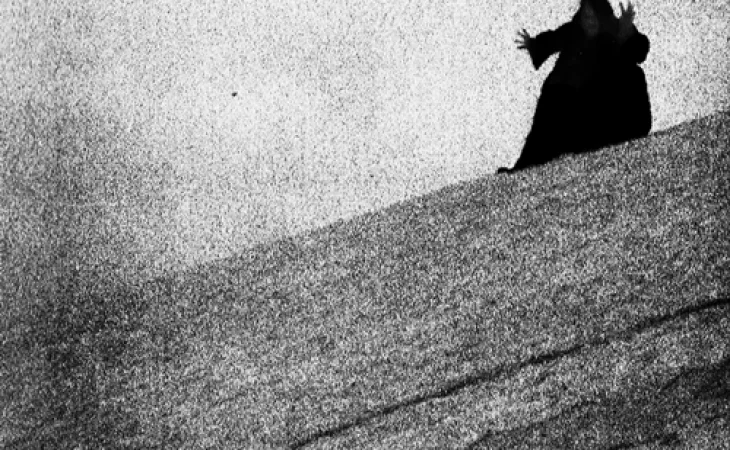
Einsamkeit (2007), just three tracks but sprawling ones, arrives after a three-year hiatus. Once again, something has profoundly changed. The cosmic solemnity of "Einkehr" feels more like a pitch-black-tinged celestial new age mass than any sort of black-metal emanation. The fusion of the spatial and the unsettling, the galactic and the deadly, resembles what Darkspace developed—a band Möckl himself plays in—but only in the third composition, "Kraft," is there any heavy metal, albeit formless, atmospheric, noisy, and symphonic. To put it plainly, there isn't a single second of drums on the whole album.
A full six years pass between the album just discussed and Das Tor (2013), 71 minutes across 4 tracks. Returning to the inhuman proportions of Winterkaelte after a full 12 years, the project now presents itself refined by experience: a gentler production in terms of audio systems, bolder balances between bestial black metal and harrowing dark-ambient, and, above all, a clear return to the theme of the eternal, pitch-black winter from which it all began.
"Offenbarung" (23 minutes) opens like a funeral liturgy, battering the timpani with symphonic, lugubrious black metal, then dissolves into a colloidal, psychedelic black-doom, before closing with a poetic cosmic prayer of synthesizers. "Macht Des Schicksals" follows a similar script, also exploding into gothic flourishes, while "Ewig Leuchten Die Sterne" takes a different approach: it floods the sound spectrum with deafening guitar distortion that barely conceals a funeral march, made visible as the arrangement thins out; as if propelled by some miraculous force, the tragic threnody rises into an interstellar chant and fades into that wind which has by now become the trademark of the whole project. Closing things out is "Schluessel", caught in the full grip of a whirlwind of despair and anxiety, before turning into a cosmic tribute worthy of Tangerine Dream.
What the album achieves, above all, is to renew hope for a future for Paysage d'Hiver, without the project losing its identity. Like Paysage d'Hiver (1999) and Winterkaelte (2001), it's an effective way to explore Möckl's wintry world without getting lost in the vast demo catalogue.
Meanwhile, the compilation Das Gletschertor/ Das Schwarze Metall-Eisen (2020) is also released, gathering two long compositions that are otherwise hard to track down.
It takes as long as 7 years for the follow-up to arrive, Im Wald (2020), probably his definitive work: 120 minutes, a full 13 tracks, initially released in a limited edition that only fuels the author's niche cult following. The entire 22-year stylistic exploration returns here, reassembled into a new system. In January the work is also released on USB sticks housed in hand-carved wooden cases, but only in fifty copies reserved for a select group of participants: an exclusive way of unveiling the album. Only in June is it given a wider release, in double-CD format or as a quadruple vinyl in an elegant, limited-edition wooden box put out by Möckl's own label, Kunsthall Produktionen.
Out of the familiar icy wind emerges the opening assault of "Im Winterwald", an obsessive black metal track overshadowed by menacing atmospheric chords that blanket it like a layer of low, dark clouds. The exploration of the titular forest ideally continues in "Über den Bäumen", more melodic and epic, and then, past the desolate melody of the short "Schneeglitzern", finds in "Alt" an abyss of despair to plunge into. Another brief interlude leads into "Stimmen im Wald": the voices in the forest echo monstrously, forming a mournful choir that, in its almost liturgical solemnity, stands in stark contrast to the raging bestial power of the black metal around it.
Breaking up the succession of assaults comes "Flug", opened by a threnody of guitar and synth before being pared down to a dark ambient sound that seems to come from another world, 11 minutes that grant the drums a little respite and set the stage for the album's second half.
"Le rêve lucide" strikes with renewed violence, before revealing a mournful melodic side and even a violin, a faint voice amid the storm. That hope, though, is betrayed by the most lo-fi track of the bunch, "Kälteschauer", nearly 13 minutes of low-fidelity ferocity that briefly take on a cosmic grandeur thanks to the synths.
Closing out the journey are "Weiter, immer weiter", true to its title an obsessive loop in the form of a black metal so saturated it borders on wall of noise, and the lengthy "So hallt es wider" — long even by the standards of an album overflowing with tracks past the ten-minute mark: over its 19-plus minutes, a funereal guitar toll gives way to a spectral melody and then a ferocious gallop, broken after five minutes by a tense pause; by the eighth minute the track seems almost to shatter, only to pull itself back together for a further savage onslaught, the definitive climax, followed by a long coda fading away into darkness.
Im Wald seems to work as a synthesis — admittedly a somewhat long-winded one — of everything laid out across the rich discography that came before. It's a journey-album that alternates melodic, epic surges with numerous outbursts, often fusing these two souls into shifting, contrast-laden compositions. It plays an important role in the story of Paysage d'Hiver and opens a new chapter for the project, one that will form a trilogy together with the subsequent Geister (2021) and Die Berge (2024).
The two lengthy tracks on the EP Im Traum (2020), which emerge from icy mists to land on distinctly cosmic visions, along with the compilation Schnee (2020), which brings together rarities scattered across the project's most underground years, make this a particularly fertile period.
The second official album of a project now 24 years old, Geister (2021), is already an event in its own right, so it's only natural to expect something more from these 11 tracks than mere additions to an already vast catalogue. From the moment opener "Schattä" kicks in, a very deliberate sonic choice is apparent, one that in this case favours the guitar riffs as the main protagonists and gives the vocals a prominent role in the mix. Where once the winter vision was more a matter of atmosphere, a dismal nocturnal emanation, this time it's a face-to-face confrontation with the demons of suffering. Sharper-edged, screamed and more direct, this new work takes the shape of a solemn torture on "Bluet" and links black metal back to punk on "Wüetig", restating a point that Darkthrone, too, made abundantly clear. The change in format is also evident, opting for shorter tracks than in the past, which are also prone to slowing into resounding mid-tempos ("Undä", "Wärzä", "Schuurig") or the fearsome, pachyderm-like gait that breaks up the ending of "Anders". These choices bring about a certain underlying homogeneity, heightened by a notably narrow dynamic range in volume.
Within this dense sonic matter, which gives the drums little respite, a restless Tobias Möckl seems to be thrashing about, and only on the closing "Geischtr" does he refrain from screaming like a man possessed. In these final ten minutes, the project's more visionary side returns, its metaphysical reflection. It's a striking conclusion, one that contrasts vividly with the fury of the rest of the work and ideally serves as an interdimensional border between our world and the dark, infernal one of Paysage d'Hiver.
Icy, inhospitable mountains are the setting through which the mysterious protagonist of the project's third official album moves. These towering rock giants, forbidding and majestic, unsettling yet captivating, provide the inspiration for a new, colossal journey of over 100 (!) minutes titled Die Berge (2024), steeped in atmospheric, ferocious black metal, hypnotic in its obsessive repetition.
Compared to the more defined sound of its predecessors Im Wald and Geister, Die Berge seeks a more explicit connection to the project's earliest demo releases, without setting aside the greater compositional complexity that has emerged in recent years. The colossal "Urgrund" takes only a few seconds of its 18 minutes to draw the listener into the freezing mountain landscape, then unveils a majestic distorted electric guitar riff and — once synths, drums and finally vocals are added — paints an infernal picture. This symphony of ice, assailed by monstrous, unintelligible vocals, moves through bursts of fury and slowdowns, always at deafening volume and never granting the listener a moment's pause: a storm-suite that only loosens its grip in the finale, intoning a desolate melody.
If “Urgrund” describes the setting, “Verinnerlichung”, over its 15 minutes, leads into the protagonist's soul, bringing us to the very center of his pain: a composition of terrifying intensity, driven by dismal chords and a frenetic, obsessive drumming that proceeds through small variations, letting a melody glimmer through the fog; halfway through, the drums stop for a moment, only to resume shortly after and carry on the torment, all the way to the long coda dominated by distorted guitars.
The heart of the work is dominated by the triptych of “Transzendenz”, a total of 34 minutes in which Paysage d’Hiver returns to its more abstract, atmospheric origins, leaving ample room for the project's ambient side, especially in the slow, desolate second part and the even more atmospheric, dismal third part — essentially an arctic funeral march in which the voice is replaced by lead guitar, intoning a forlorn melody that fades into darkness.
The 18 minutes of “Ausstieg” abandon the lyricism and return fiercely to the searing pain, to the inhuman intensity of “Verinnerlichung”, though in its final stretch it shifts toward a more nuanced synthesis of anguished black metal and a sweet, hope-laden melody. It's a long-awaited patch of blue sky after the immense storm, an escape route and a taste of calm that inevitably becomes tainted by the pain endured before it.
The closing “Gipfel” brightens the arrangement, scales back the menacing reverbs and echoes, but still affirms the majestic, annihilating tone: it's doom-paced black metal, inlaid with guitar melodies and bolstered by synth orchestrations that finally lead us out of the mountains.
With Die Berge we find the synthesis between the earliest Paysage d'Hiver and the sound of the more recent albums. It's a demanding proposition that requires total surrender from the listener, for a full immersion into a world of terror and wonder. The protagonist of the entire Paysage d'Hiver narrative universe, the mysterious wanderer who may represent an alter ego of Tobias Möckl, meets his fate with Die Berge, and this could mark either the conclusion of the entire project or, more simply, the end of a long narrative cycle in this saga of ice. Either way, it stands as one of the peaks of a career spanning over twenty years, with few parallels in the history of black metal.
27 years after the wind first rose and 26 after the first demo, this winter landscape remains a dark, menacing land, growing ever stronger in its eternal desolation. Even with long pauses, moments of crisis and rebirth, it has always been a musical project with a clear underground dimension, demanding dedication and patience, and offering in return a glimpse of a mesmerizing yet unsettling picture: it is a window onto the seemingly eternal winter of the soul.
Add OndaRock to your favorite sources on Google Discover. Don't miss our reviews, milestones and latest news straight in your feed.
| Steineiche (Kunsthall, 1998) | ||
| Schattengang (Kunsthall, 1998) | ||
| Die Festung (Kunsthall, 1998) | ||
| Kerker (Kunsthall, 1999) | ||
| Paysage d'Hiver (Kunsthall, 1999) |  |
|
| Kristall & Isa (Kunsthall, 2000) | ||
| Winterkälte (Kunsthall, 2001) | |
|
| Nacht (Kunsthall, 2004) | ||
| Einsamkeit (Kunsthall, 2007) | ||
| Das Tor (Kunsthall, 2013) | ||
| In Wald (Kunsthall, 2020) | |
|
| Geister (Kunsthall, 2021) | ||
| Die Berge (Kunsthall, 2024) | |
 MilestoneRecommended by OR


