


Mechanical and brutal, visionary and experimental, Fear Factory were the most creative band in 90s industrial metal. We retrace a career spanning more than two decades of line-up changes, evolutions and reinventions, in search of the metal of the future
We are the new breed, we are the future
(from “New Breed”)
Over the course of the '80s, the spread of musical extremism is sensational. The heavy-metal genre thus morphs into something ever more violent, bleak and horrific thanks to the first death-metal experiments. Among the essential bands of this style are Death and Morbid Angel, who influence countless groups with their sonic approach. On similarly extreme shores, Napalm Death instead christened another extreme musical style, perhaps the extreme style par excellence: grindcore. One of the members of the nihilistic, brutal English outfit, Justin Broadrick, plays guitar, sings in a monstrous voice and programs the drum-machines in another band as well, one of the most fearsome of the '80s and '90s: Godflesh. Mechanical sounds, inhuman to the core, telling of psychological and physical torture in a dystopian world, already laid out for listeners on the masterpiece Streetcleaner (1989). With Godflesh, it's fair to speak of experimentation and industrial-metal.
The influence of Napalm Death and Godflesh is such that, across the ocean, a band called Ulceration is born, drawing on death-metal (Death, Morbid Angel), the most extreme thrash (Slayer, Sepultura), grindcore (Napalm Death, Terrorizer, Carcass) and industrial-metal (not just Godflesh but also Ministry and Skinny Puppy). In 1990, to better reflect their passion for the dystopian world depicted by Godflesh, Ulceration ditch a name as blunt as it is lacking in charisma, opting instead for the far more evocative Fear Factory. Initially there are four members: Dino Cazares (guitar), Raymond Herrera (drums), Dave Gibney (bass) and Burton C. Bell (vocals). The lineup is ready to record its first demos, cut in 1991 and later collected in 2002 on Concrete, chronologically the earliest document of the band's sound. For anyone not used to the overwhelming impact of grindcore and industrial-metal, it's a terrifying calling card. "Big God/Raped Souls" injects angelic voices into a death-metal slaughterhouse, as if belonging to ethereal, inhuman digital creatures. "Concrete" opens with a grindcore blast only barely diluted into furious death-metal. "Echoes Of Innocence" proves more varied: a doom-laden start, death-grindcore bursts and desolate industrial digressions. At the very least, "Self Immolation" already shows itself, even in this version, to be a mature fusion of the industrial, the violent and the experimental, a terrifying offspring of Einstürzende Neubauten, Godflesh and Napalm Death.
Intended to be the band's debut album, Concrete bears the mark of a production — courtesy of Ross Robinson, recorded at Steven Edward Duren's studios — that doesn't seem to bring out the band's stylistic qualities as it should. On top of that, the contract doesn't fully satisfy the Hispanic-American outfit, who decide to part ways with Robinson. A brief legal dispute ensues, resolved with Fear Factory retaining the rights to the songs themselves, while Robinson keeps the rights to the recorded album. The only solution is to shelve the release and re-record the material, which is indeed what happens with eight tracks that go on to make up the actual debut: specifically "Big God/Raped Souls", "Arise Above Oppression", "Crisis", "Escape Confusion", "Dragged Down By The Weight Of Existence" (renamed "W.O.E"), "Desecrate", "Suffer Age" and "Self Immolation".
In August 1992, the menacing, evocative title Soul Of A New Machine, borrowed from a book by Tracy Kidder, unveils the factory of fear to the world. What the album represents is more than just an extreme-metal record. It is in fact a seminal crossroads between the aggression of thrash-metal (Dark Angel above all, especially in terms of drumming), the violence and rot of death-metal and grindcore, and the claustrophobic imagery of the darkest, most savage industrial music. This blend finds its fullest expression starting with the lyrics: a trait that will remain a constant throughout the evolution of the Fear Factory sound is the unsettling sci-fi concept album. Soul Of A New Machine kicks off the band's narrative by introducing a world in which humanity has created a hyper-technological society where machines are slowly taking over, starting with governmental bodies. Within this setting, a sentient machine endowed with a soul is created, with clear nods to dystopian and cyberpunk imagery.
Not all the songs, however, focus for now on this dominant theme, which instead serves more as a backdrop against which the songs are set, tackling protest against war, police abuse, and even toxic interpersonal relationships. The result is disorienting: as if the typical lyrical character of thrash-metal had been cloaked in Godflesh's nightmarish tones.
On this debut, Burton C. Bell gets the chance to test out the alternation between a death-metal roar and more traditional, even filtered, sung parts. Dino Cazares establishes himself as the band's leader, taking on the roles of guitarist, arranger, mixing engineer and even bass recorder, with the instrument played live by Andrew Shives. Cazares' sound is often markedly rhythmic, hugely influential on the alternative-metal scene taking shape in the early '90s and on the new attention to "groove" within much extreme metal. Behind the kit, Raymond Herrera alternates between mechanical and furious. The new producer is Colin Richardson.
From the opening "Martyr" onward, it's a new musical world, of startling violence and suffocating post-industrial modernity. When the faint voice enters amid the apocalyptic setting that's been built up, it's like the dreamlike vision of some cold, inhuman dimension within the atrocious carnage of a bombing raid. Even when they lean more heavily into death-metal and grindcore, Fear Factory render it with a mechanical bent ("Leechmaster", "Scapegoat", "Crisis", "Scumgrief"), with moments of deranged, schizophrenic outbursts of rage, like "Lifeblind", a rhythmic tour de force.
The new versions of the Concrete tracks are decidedly more focused on conveying the band's distinctive sound — just listen to "Big God/Raped Souls", which showcases both the mechanical soul and the brutal one, blood mixing with microchip. The closing "Manipulation" underlines the band's influence on new rhythmic approaches within extreme metal, a role that on this album lets them stand alongside Meshuggah as major influences on '90s thrash-metal and evolved death-metal. Igor Cavalera, the legendary Sepultura drummer (whose early thrash/death albums are among the band's own sources of inspiration), wouldn't hold back in praising this release, calling it "the future of death-metal".
One stylistic tendency that Fear Factory take from the industrial-metal world is their dialogue — however subtle and calculated — with electronic composition. This shows up in the use of sampling, a central element of industrial culture since the days of Throbbing Gristle, but also in an openness to the concept of the remix. Fear Is the Mindkiller (1993) reworks the tracks from Soul Of A New Machine in a decidedly more danceable key, without sacrificing any of their devastating power. The "pigfuck mix" of "Scapegoat" seems tailor-made to set off metalheads fresh out of a pit that's already left bruises and injuries. With hindsight, it's a taste of the industrial-metal revolution the band would unleash a couple of years later with the masterpiece Demanufacture (1995).
For their second official album, Burton C. Bell writes the lyrics while Dino Cazares handles composition. Bell focuses on a more solid concept, following the life of a man fighting against a government controlled by machines. His vocal style moves away from the death-metal of the debut, toward an aggressive, more thrash-like scream that alternates with increasingly frequent clean-sung parts. The latter will, over time, become one of Bell's most distinctive traits — highly personal in tone, faintly melancholic — and will go on to influence singers in numerous bands, even very different ones, such as Machine Head or Soilwork, but above all within nu-metal.
Cazares develops his guitar style further, once again moving away from the death-metal elements of the debut and closer to thrash tradition. At the same time, Cazares' riffing incorporates the low, heavy tones of the groove-metal born in those years (Pantera, Sepultura, Machine Head and, in a more industrial variant, Prong), developing through numbing, mechanical rhythms, markedly industrial-metal in their obsessiveness and harsh repetitiveness, with which the guitarist indulges himself freely, enriching them further with elaborate, almost mathematical constructions. Raymond Herrera and Cazares form an inhuman rhythm section, relying on power and precision to deliver a terrifying amalgam of deafening beats and mechanical bursts. Herrera proves a phenomenal drummer, fast and surgical, a worthy heir to Gene Hoglan (Dark Angel, Death) and Igor Cavalera (Sepultura) in his ability to combine power and precision. On paper there's also a bassist credited on the album, Christian Olde Wolbers, who completes the band's classic lineup, though some years later Cazares would reveal that every bass line was actually recorded by him personally, as Wolbers had joined the band too late to take part in the recordings.
This time the concept is fully formed and serves as the entire backbone of the compositions: inspired by the two "Terminator" films (from which some of the samples are taken), the album tells the story of one man's revolt against a machine-run government that controls a ruthless, dystopian police state.
Colin Richardson produces an initial version of the album, but it fails to win over the band, who are determined to move away from the sound of their debut. Greg Reely and Rhys Fulber step in instead, able to support the group's experimental spirit. This choice may have influenced one of the main points of discontinuity with Soul Of A New Machine: the greater prominence of the electronic component, which here fuses completely with the thrash, death and groove-metal-derived sounds.
The title track opens on a mechanical, unsettling rhythm, veers into industrial thrash-metal and finally explodes into metallic extremism and atmospheric slowdowns. Human and inhuman, fused together, also in "Self Bias Resistor", this time with filtered, aseptic vocals acting as an alienating contrast. One of the high points of this essential album is "Zero Signal", opened by an alien mechanical symphony that sets placid, abstract melodies against the monstrous rhythmic interplay of guitar, bass and drums. The gentle singing, rather than soothing the atmosphere, makes everything disturbing instead, then supersonic arpeggiators kick in, and only a thinning of Herrera's powerful beats lets a few rays of light filter through the apocalypse, aided by a piano.
Needless to say, what follows is an ecstasy of violence: "Replica" also brings back the grindcore blasts of their early days, while "New Breed" outdoes everything else on the record in sheer eccentricity. Heavy electronic effects, filtered vocals, devastating rhythmic blasts, mechanical guitars that sound like the roar of inhuman machinery, and an entire electronic framework supporting one of the most powerful tracks in the history of metal, barely three minutes of calculated violence. The intensity is such that the ending, with a choir backing Bell's screams, leaves you as stunned as you are hungry for more devastating musical violence. Quite unexpectedly, a cover then arrives, "Dog Day Sunrise" by Head Of David, half tribute and half appropriation of a track that itself influenced the very industrial-metal sound so beloved by Fear Factory. The unstable balance between what is human and what is not, whose only point of collision is an intolerable violence, seems on the verge of causing tracks like "Flashpoint" to collapse, which makes it all the more surprising that a moving pathos emerges in the closing moments of "Pisschrist".
"A Therapy For Pain" (nearly 10 minutes long) closes the album with another twist: a desolate, galactic symphony, ending in alien hallucinations that have nothing to do with industrial or any form of metal. The ideal seal on a creative and terrifying album, a concentrate of innovation and power with few equals, nearly all of which are, in one way or another, indebted to this album's influence (think of Strapping Young Lad, to name the most significant in the extreme-metal field).
The remix album Remanufacture – Cloning Technology (1997) sounds, this time, less surprising, given that the electronic soul of the band was already well developed on Demanufacture. The result is often messy, partly because tinkering with the surgical devices the band had built means settling for imperfect solutions that poorly convey the power and visionary force of the originals. The most curious moment is "Bound For Forgiveness" (the remix of "A Therapy For Pain"), but too often it seems the various artists involved simply went through the motions without much creative flair.

The follow-up to Demanufacture begins to take shape in late 1997, when metal deity Ozzy Osbourne asks the band to open for the founding fathers Black Sabbath at two sold-out shows in their hometown of Birmingham. After this thrilling opportunity to raise their profile, the band begins to envision an artistic future beyond an album that had been definitive both creatively and conceptually: a sequel to the apocalyptic, dystopian narrative, a further evolution of a terminal, experimental sound. The solution comes from the idea of continuing the story begun with Demanufacture on the new album, titled Obsolete (rendered on the cover as °BSΩLE+e), released in June 1998.
Machines have definitively taken over, according to a pessimistic vision that has more than a little in common with the imagery of James Cameron's "Terminator", but which, in its tone and dystopian ideas, also connects to Huxley's "Brave New World" and Orwell's "1984". Bell describes it this way: "We've reached the point in history where man is obsolete. Man created these machines to make his life easier, but in the long run they've made him obsolete. The very machines he created are now destroying him. Man is no longer the primary citizen on Earth." Only one person opposes this technological nightmare, whom the band names Edgecrusher.
Illustrator Dave McKean is tasked with translating the band's narrative ideas into images for the booklet. Even setting aside the storyline, steeped in political rebellion and science fiction, the album contains several innovative elements. Cazares has detuned his guitar, now a seven-string, giving free rein to the rhythmic obsession that had led the band to go without a single guitar solo up to this point in their career. The new sound, darker, more relentless, cadenced and terrifying, draws partly on the syncopated riffing of nu-metal (Korn, early Deftones), but in turn would go on to influence the scene's most aggressive bands. Bell follows this growing focus on rhythm, ending up almost rapping, albeit aggressively, when he's not singing in his usual aseptic tone. Herrera had already displayed a growing passion for double-kick drumming, but it's on Obsolete that he perfects increasingly mechanical, angular rhythms that sound as if they come from a drum machine in revolt against humanity.
While it doesn't match the depth of Demanufacture, which would have been a near-miraculous feat, the album contains some of their greatest tracks. The devastating opener "Shock" manages to be singable despite the carnage it stages, while "Edgecrusher" features an upright bass, a storm of scratching, furious vocals and, ultimately, every hallmark that defines the record. The machine-gun rhythms of "Securitron (Police State 2000)" harken back to the grindcore fits of their early days, now folded into the mature, multifaceted amalgam the band has forged. The tension of "Hi-Tech Hate" is fuelled by a stumbling rhythm, though Herrera and Cazares are at their best on the mechanical pulse of the title track. Overall less brutal, at least relative to a discography full of savagery, the album also includes a "Resurrection" on which Bell sings without resorting to roars or screams, foreshadowing the band's more melodic future.
Surprisingly, Obsolete becomes one of metal's bestsellers, thanks to an atypical single like "Cars", a remix of the Gary Numan song sung by Numan himself, included on the digipak edition. Climbing to number 57 on the UK charts with this quirky example of a hit, Fear Factory manage to sell 750,000 copies of the album by 2001.
The dystopian trilogy comes to a close with Digimortal (2001), a more immediate and melodic album but still capable of satisfying anyone seeking a strong jolt. The record marks the definitive fusion of industrial-metal, groove-metal and the by-then hugely popular nu-metal, and it's precisely for this last reason that it runs into the disdain of the metal audience, posting disappointing sales figures. The album still has a few tricks up its sleeve, however, and boasts several interesting moments. Close to Sepultura on the catchy opener "What Will Become" and to Korn on the syncopated title track "Digimortal" and on the industrial-rap-metal of "Back The Fuck Up", Fear Factory find themselves unusually straightforward on tracks like "No One", continuing a process of simplification already glimpsed on Obsolete, which unfortunately veers into over-simplification on the single "Linchpin".
There's even a textbook ballad like "Invisible Wounds (Dark Bodies)", and to recapture the industrial nightmare of old you have to settle for "Byte Block" and "Hurt Conveyor". While in their more accessible form these tracks reveal some compositional limits, "(Memory Imprints) Never End" closes the album with a scream-laden ballad that still leaves room to hope for an evolution that doesn't sacrifice too much of the band's creativity.
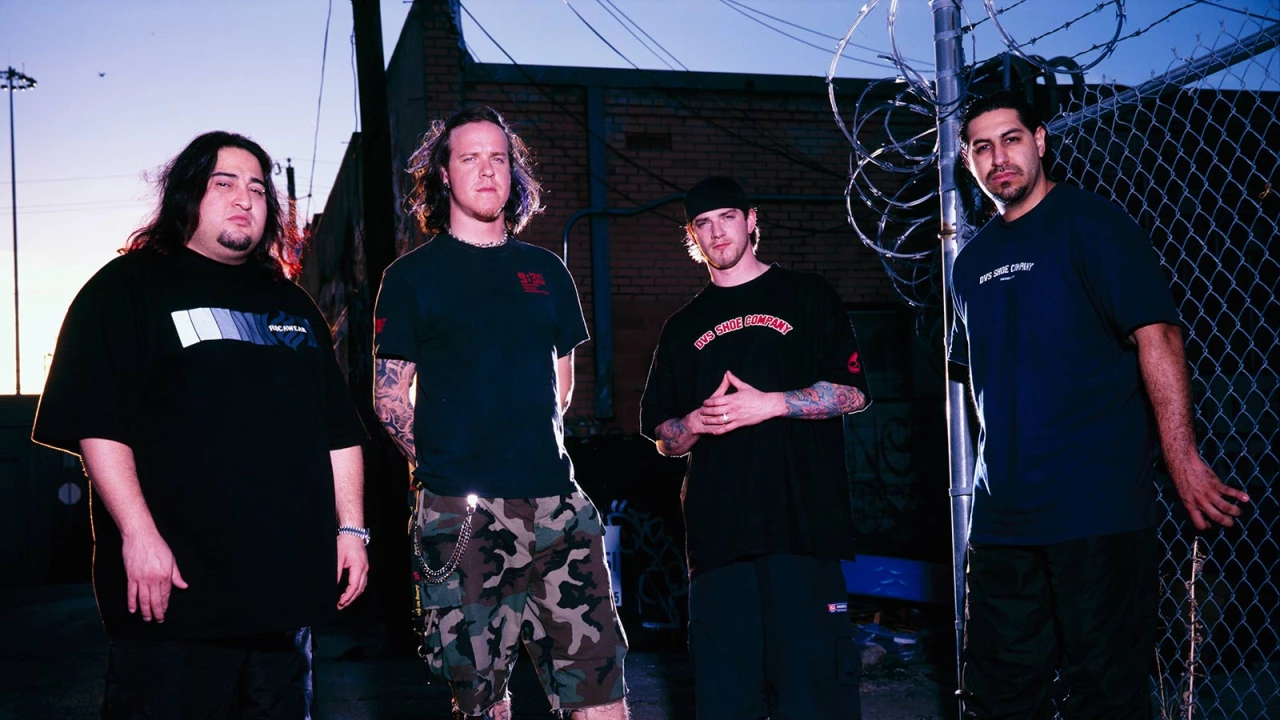
It's a shame that after wrapping up a trilogy that was already showing signs of overindulgence, the band was headed for collapse. Clear tension begins to surface between Bell and Cazares, seemingly irreconcilable, to the point that the latter (who had grown tired of playing extreme metal and wanted to start an indie-rock band, much to his bandmates' dismay) abruptly quits the group in March 2002, causing it to disband.
Things get so bad that the former members start pointing fingers at each other and trading jabs through interviews. Cazares accuses Wolbers and Herrera of only being interested in the money; Herrera fires back with a mirror image of the same criticism (going so far as to accuse Cazares of trying to strike deals with the label and management behind the others' backs) and adds that Cazares acted like a petty dictator, arrogantly shooting down every musical idea proposed by the other musicians, often openly disrespecting people.
Whatever really happened, in order to honor contractual obligations with Roadrunner, the band still put out the previously discussed Concrete (2002) and the compilation Hatefiles (2003), a grab-bag of B-sides and remixes that will delight completists. Meanwhile, Bell decides to form Ascension of the Watchers with John Bechdel, though it will take time to get off the ground. Cazares, for his part, hasn't exactly been sitting idle outside the "fear factory": the guitarist has long been involved with the grindcore project Brujeria (notably on their 1993 debut "Matando Gueros") and, at the turn of the millennium, founds the death-grind band Asesino, as well as serving as the sole constant member of the devastating Divine Heresy. It's with Asesino that Cazares focuses his energy, while Herrera and Wolbers meet up in late 2002 and decide to rebuild Fear Factory on their own terms.
In 2004, a lineup featuring Burton C. Bell on vocals (talked into returning to the fold by the other two, despite his waning interest in metal), Raymond Herrera on drums and Christian Olde Wolbers on guitar and bass, backed by John Bechdel on keyboards, releases Archetype. Anyone who had given up hope of a return to the old armored sound will find a welcome surprise in the annihilating physical impact of tracks like "Cyber Waste" and "Act Of God", intense enough to stand alongside Demanufacture, while "Bonescraper" sounds like it could have come off Obsolete. It's also a return to the band's rhythmic barrages, as "Drones" proves, though a catchier slice of electro-metal like "Archetype" makes clear that something has indeed changed, and the big ballads "Bite The Hand That Bleeds" and "Human Shields" still expose the band's creative weak spot, slipping into cliché.
If this weren't the album of a band with such a remarkable past, Archetype would stand out as a record worth remembering, at least among its contemporaries. It even features, in the seven-minute "Ascension", an ambient, cosmic rarefaction worthy of Klaus Schulze, and closes with a cover of Nirvana's "School".
For the first time, Fear Factory seem content to simply play themselves without taking many risks, cashing in on the ideas from what by this point already looks like their "classic" period, that of the dystopian industrial-metal trilogy.
With Transgression (2005), however, things change. "Echo Of My Scream" and "New Promise" feature the first guitar solos of the band's entire career, and the industrial element has been fading, to the point of becoming hard to detect in many tracks. It seems the pressure to deliver a new release had a negative effect on the final result, leading to an output that feels rushed, sloppy and thinner than the band's past work, with poor production and an excessive number of covers padding out the tracklist. Comparing the title track with songs from previous albums reveals arrangements with far less sonic density, which, rather than coming across as intricate industrial-thrash-metal machinery, often sound like mere displays of power, incapable of unsettling anyone who's even casually listened to the band's earlier discography. But part of the blame also lies with the poor chemistry between producer Toby Wright and Bell on one side — with Bell taking charge of production and arrangements, favoring the more melodic compositions and discarding the more aggressive ones — and the rest of the band on the other.
While the opening quartet of tracks mostly feels like an uninspired addition to what's already been heard, "Empty Vision" shows a leaning toward catchy, pop-inflected melodies, most evident on tracks like "Supernova" and "I Will Follow", a cover of U2. The ballad "Echo Of My Scream" isn't just toothless, it slips into the same cliché as countless metal bands chasing a more emotional angle. The closing "Moment Of Impact" wraps up an uneven and seemingly thrown-together second half of the album, which, besides the aforementioned U2 cover, also includes a cover of Killing Joke's "Millennium".
Wolbers would later criticize the Bell/Wright duo's approach and the new label's pressure over the deadline, calling the album a shoddy, half-baked piece of work ("I am not proud of at all. It's crap", he'll say bluntly). Bell, on the other hand, will show pride in it.

Following the controversial Transgression, the band falls into crisis once again and enters an indefinite hiatus. Bell contributes to “The Last Sucker” by Ministry (2007), making no secret in interviews of his enthusiasm at collaborating with one of his musical idols, and shortly afterward manages to release the debut and, to date, only album by Ascension of the Watchers, “Numinosum,” a hazy, atmospheric record steeped in gothic-rock with dreamy, industrial, electronic and even prog shades. The result is uneven, but a fine cover of “Sounds Of Silence” stands out.
Meanwhile, Bell also announces, quite publicly, that he no longer wants to contribute to the world's violence through Fear Factory's aggressive music (!). Wolbers and Herrera decide to go their own way and form Arkea, a metalcore band that releases just one album, “Years In The Darkness” (2009), containing many ideas the pair had originally intended for a new Fear Factory record.
Years go by with no sign of a reunion on the horizon, until, somewhat surprisingly, in April 2009 Cazares (who in 2007 had also launched Divine Heresy, steeped in technical deathcore) and Bell suddenly declare themselves friends again out of the blue. Herrera and Wobers want nothing to do with Cazares and turn down Bell's invitation to a reunion, prompting him to take control of the operation himself. A new line-up is thus unveiled, with Byron Stroud on bass and none other than Gene Hoglan on drums (previously of Testament, Death, Strapping Young Lad and Dark Angel).
The decision also causes contractual headaches, to the point of forcing the band to cancel several shows because, technically, Herrera and Wobers were still members of the group and held half the rights to the name. For a while there's even the bizarre possibility that the two opposing camps might each go their own way while using the same name. “It's as if the two of them had decided to start a new band and call it Fear Factory too, without telling us,” Herrera quips sarcastically in interviews. Cazares once again accuses the pair of being interested only in money, and the whole affair turns into something of a long-distance soap opera, fought out through jabs in interviews and social media posts. In the end, Herrera and Wobers decide not to pursue legal action, and so Bell and Cazares go on their own way.
With the two reunited friends as the only original members left, Mechanize (2010) tries to reclaim the band's prominent place within the heaviest corners of metal. They open with the title track, the most screamed-out song in their catalogue and gloriously packed with electronic elements. While still making sporadic use of melodic vocals, new onslaughts like “Industrial Discipline” and “Powershifter” call back to the first two albums, death-metal excess and grindcore blasts included.
“Designing The Enemy” attempts a fusion of violence and melody that's far more creative than the ballads found on previous records, while “Metallic Division” delivers 90 seconds of industrial clangor over one of their killer grooves: it's a return to less conventional musical forms that harks back to the band's classic period, that of the “trilogy.”
Perhaps it was Cazares' return, or perhaps finding fresh inspiration through the line-up change, but even the closing “Final Exit,” clocking in at over eight minutes, ends on an unexpected piano soliloquy amid sparse dark-ambient reverb.
A welcome return, then, for the Factory of Fear, which, while not exactly astonishing, at least brings to mind their landmark records of the '90s.
With The Industrialist (2012), they even return to the concept-album format, with yet another dystopian tale of a machine turning threatening and lethal to humanity. This time Bell and Cazares are the only official members, relying on a drum-machine programmed with the help of John Sankey. Production and other supporting musical contributions come from longtime collaborator Rhys Fulber. Release date aside, the album could easily pass as a credible sequel to Demanufacture, replicating its impressive power (“The Industrialist,” “Recharger,” “Difference Engine”), its rhythmic obsession (“Depraved Mind Murder”), and its taste for outlandish, cyber-punk-tinged arrangement choices.
The groove-metal and thrash-metal souls are bound together by a shared passion for industrial sounds, in an album that offers nothing truly new, not even in the closing nine-minute dark-ambient piece “Human Augmentation,” but rather feels like confirmation that Bell and Cazares are still capable of giving fans of Demanufacture and Obsolete more songs in that same style.
The whole troubled attempt at evolution that Fear Factory have pursued since the turn of the millennium finds its synthesis in Genexus (2015). Live drumming makes a partial comeback, this time courtesy of Mike Heller, and once again this is an album that revisits themes spanning an entire career: mechanization, cyber-punk nightmares, violence and dystopia. The melody that had taken over on Transgression is present here without being intrusive, still paired with that fusion of industrial-metal, groove-metal and thrash-metal that has defined the band for the past couple of decades.
“Soul Hacker” could have come straight off Obsolete, while “Genexus” attempts an industrial-flavored orchestration that leans more toward the symphonic than the cyber-punk: it's a return to their own past that at times becomes a glance toward solutions that seem to belong to the metal of ten or twenty years earlier. One of the few new touches lies in the beats of certain tracks, which no longer mimic traditional drums and instead give in to distinctly electronic sounds, as is the case with the lengthy “Expiration Date,” nearly nine minutes of android ballad closed out by menacing mechanical noise.
These are little more than details on a ninth studio album that confirms Fear Factory as musicians now far removed from their most experimental and creative period, yet still determined to assert their role as experimenters, innovators and legends of the industrial-metal scene.
The Fear Factory of Aggression Continuum (2021) no longer exist by the time of its release. The American band's tenth album reaches our ears a full six years after Genexus, and the vocal parts recorded by longtime singer Burton C. Bell date all the way back to 2017. In the meantime, Bell has parted ways with the band, and its future looks increasingly uncertain, with only Dino Cazares, handling bass and guitar, left to represent the original lineup. Whether it's correct to read this record as a farewell, though, only time will tell. Either way, the tracklist offers little that the band hasn't already thoroughly covered across their long and distinguished discography. The album is, above all, an excuse to listen to, talk about, and write about Fear Factory once more. The Los Angeles band remain firmly in command of their sound, which they wield without difficulty or reinvention on what may be their tenth and final album. Those who have loved them, and still feel a thrill hearing their signature style, probably hope it isn't.
The remix album Recoded (2022) and the reissue of The Industrialist titled Re-Industrialized (2023, with drums re-recorded by Mike Heller and other minor changes) are minor additions that seem aimed solely at completists.
Thanks to Alessandro Mattedi for the corrections and helpful contributions.
Add OndaRock to your favorite sources on Google Discover. Don't miss our reviews, milestones and latest news straight in your feed.
| Soul Of A New Machine (Roadrunner, 1992) |  |
|
| Fear Is The Mindkiller (Roadrunner, remix, 1993) | ||
| Demanufacture (Roadrunner, 1995) |  |
|
| Remanufacture (Roadrunner, remix, 1997) | ||
| Obsolete (Roadrunner, 1998) | |
|
| Digimortal (Roadrunner, 2001) | ||
| Concrete (Roadrunner, 2002) | ||
| Hatefiles (Roadrunner, compilation, 2003) | ||
| Archetype (Liquid 8, 2004) | ||
| Transgression (Calvin, 2005) | ||
| The Best Of Fear Factory (Roadrunner, compilation, 2006) | ||
| Mechanize (Candlelight, 2010) | ||
| The Industrialist (Candlelight, 2012) | ||
| The Complete Roadrunner Collection 1992–2001 (Roadrunner, compilation, 2012) | ||
| Genexus (Nuclear Blast, 2015) | ||
| Aggression Continuum (Nuclear Blast, 2021) | ||
| Recoded (Nuclear Blast, 2022) | ||
| Re-Industrialized (Nuclear Blast, 2023) |
MilestoneRecommended by OR


